
Champions League Betting Markets Guide: Every Option Explained
 Available in US

The first time I opened a Champions League betting menu and saw one hundred fifty different markets for a single match, I had no idea where to start. Moneyline, Asian handicap, both teams to score, first goalscorer, total corners, exact goals, team to score in both halves—the options were overwhelming and most of them made no sense to me at all.
Five years later, I've bet nearly every market type available and learned through expensive mistakes which markets offer genuine value opportunities versus which exist purely to separate casual bettors from their money. That education cost me hundreds of dollars in bets I should never have placed, on markets I didn't understand, using strategies that had no mathematical foundation.
Here's what nobody tells beginners about Champions League betting markets: more options doesn't mean more opportunities to profit. It means more opportunities to make mistakes. The sportsbooks aren't offering one hundred fifty markets per match out of generosity—they're offering them because recreational bettors can't resist betting everything, and most of those markets feature odds structures that heavily favor the house.
But understanding the full range of available markets matters because different situations call for different bet types. Sometimes a straight moneyline bet offers the best value. Other times the spread or totals present clearer edges. Occasionally an obscure prop bet on corners or cards provides the only profitable opportunity in an entire match. You can't exploit these situations if you don't understand how each market works and when it makes sense to use it.
This guide breaks down every significant Champions League betting market—how the mechanics work, what factors influence outcomes, where value typically hides, and what mistakes to avoid. Whether you're trying to understand the difference between European and Asian handicaps, figure out why your anytime goalscorer bet lost despite your player scoring, or decide whether to bet match result or double chance, we're covering all of it in practical terms without the usual betting guide nonsense that assumes you already know what you're doing.
Pre-Match Result Markets
Moneyline (1X2)
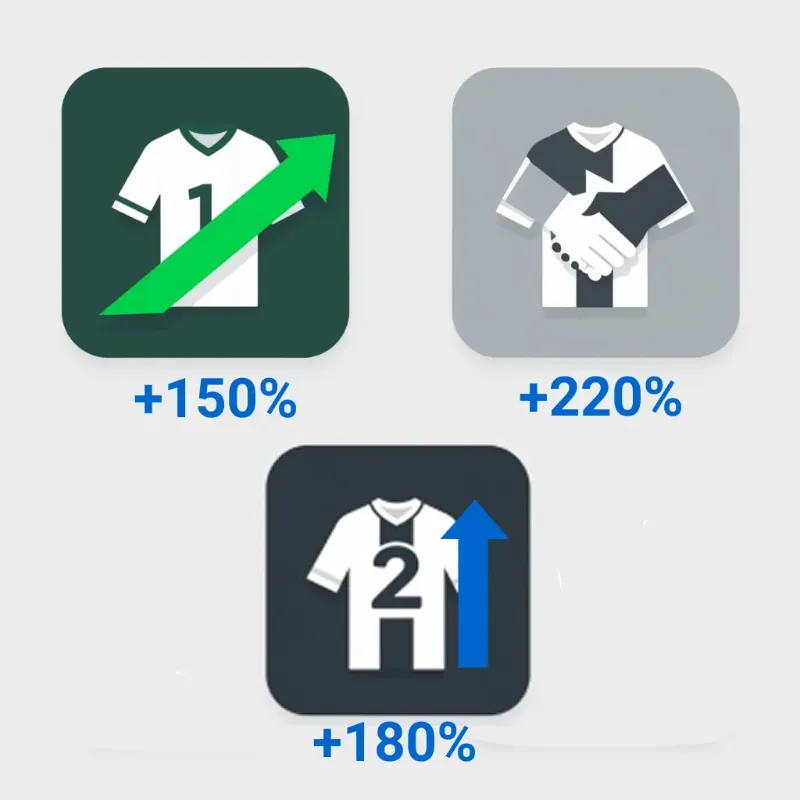
The most straightforward Champions League bet is predicting what happens in ninety minutes: home win, draw, or away win. In European terminology this market is called 1X2—one for home win, X for draw, two for away win. American sportsbooks usually label it three-way moneyline or match result.
You're picking one of three outcomes and your bet wins only if that specific result occurs in regular time. Extra time and penalties are irrelevant for this market unless you're betting on qualification or tournament winner markets. If you back Real Madrid to beat Manchester City and the match ends one-one after ninety minutes, your bet loses regardless of what happens if the match continues.
The draw option fundamentally changes the math compared to American two-way sports. In NFL betting, ties are nearly impossible and ignored. In Champions League betting, draws represent roughly twenty-five to thirty percent of all match outcomes. This isn't a longshot—it's a legitimate result that occurs frequently enough to seriously consider betting when conditions favor stalemate.
Champions League draws cluster in specific situations. First legs of knockout ties produce defensive football where neither team wants to concede, making draws more likely than underlying team quality suggests. Matches between evenly matched teams with strong defensive organization frequently stall into midfield battles with few clear chances. Late season dead rubbers where neither team has strong motivation to win often drift toward draws as energy levels drop.
Reading the odds structure tells you what bookmakers expect. When the draw is priced at +220 in a Champions League match, implied probability is roughly thirty-one percent—nearly one in three outcomes. That's not an upset; that's a common result the bookmaker expects regularly. Conversely, a draw priced at +280 or longer signals the bookmaker expects one team to impose themselves and secure victory.
The challenge with moneyline betting in Champions League is that favorites often don't offer value. When Bayern Munich is -300 to beat a weaker opponent, you're risking three hundred dollars to profit one hundred. Is Bayern really winning this match seventy-five percent of the time? Maybe, but there's no margin for error—any slight overestimation of their win probability and you're making negative expected value bets.
Underdogs on the moneyline sometimes offer sneaky value because recreational bettors avoid backing teams they expect to lose. When a decent club hosts elite opposition and their odds drift to +400, that might represent genuine value if their actual win probability is closer to twenty-two percent. The bookmaker shades the line to protect against sharp money, occasionally creating overlay situations.
Draw No Bet
Draw no bet markets remove the stalemate option from consideration. You're backing a team to win in ninety minutes, and if the match ends level, your stake returns as a push. This reduces your risk by eliminating one losing outcome, but the tradeoff is receiving shorter odds than you'd get on the straight moneyline.
This market shines in situations where you're confident a favorite won't lose but aren't certain they'll win convincingly. Manchester City hosting a defensive underdog might be -200 on the moneyline and -120 draw no bet. You're sacrificing potential profit in exchange for insurance against a draw that seems plausible given the opponent's defensive approach.
Draw no bet works particularly well in Champions League knockout stage first legs where tactical caution produces more draws than league phase matches. A team might dominate their opponent but settle for a one-one draw knowing they can finish the job in the second leg. Your draw no bet returns your stake while the moneyline bettors lose everything despite correctly identifying the stronger team.
The key question is whether the odds difference between moneyline and draw no bet justifies the reduced risk. If Bayern is -180 moneyline and -140 draw no bet, you're giving up significant potential profit for draw protection. Run the math on whether that insurance is worth the cost based on your assessment of draw probability.
Double Chance
Double chance markets let you cover two of the three possible outcomes with a single bet. You can back home win or draw, away win or draw, or home win or away win. Your bet wins if either outcome occurs, giving you two paths to victory instead of one.
The odds reflect this reduced risk—you're getting significantly shorter prices than moneyline odds because you've eliminated one losing scenario. If Liverpool is -140 to beat Napoli straight up, Liverpool or draw might be -260. That's a massive odds difference for eliminating only Napoli's win probability.
Double chance makes sense in specific situations but often represents poor value. The most common use case is backing favorites who you're confident won't lose but might not win. Chelsea or draw in a match where Chelsea is heavily favored but facing a defensive opponent provides safety while still offering profit potential.
The home or away option (eliminating the draw) is rarely worth betting because you're basically saying "somebody will win" which isn't particularly insightful. The odds on this selection are usually terrible because draws are common enough in Champions League that removing them doesn't dramatically reduce the bookmaker's risk.
Where double chance occasionally offers value is backing strong away teams in matches where a draw would be an acceptable result for them tactically. If Real Madrid travels to a difficult venue and Madrid or draw is available at reasonable odds, you're covering both the scenario where Madrid wins and the scenario where they secure a valuable away point.
Handicap Markets Demystified
European Handicap
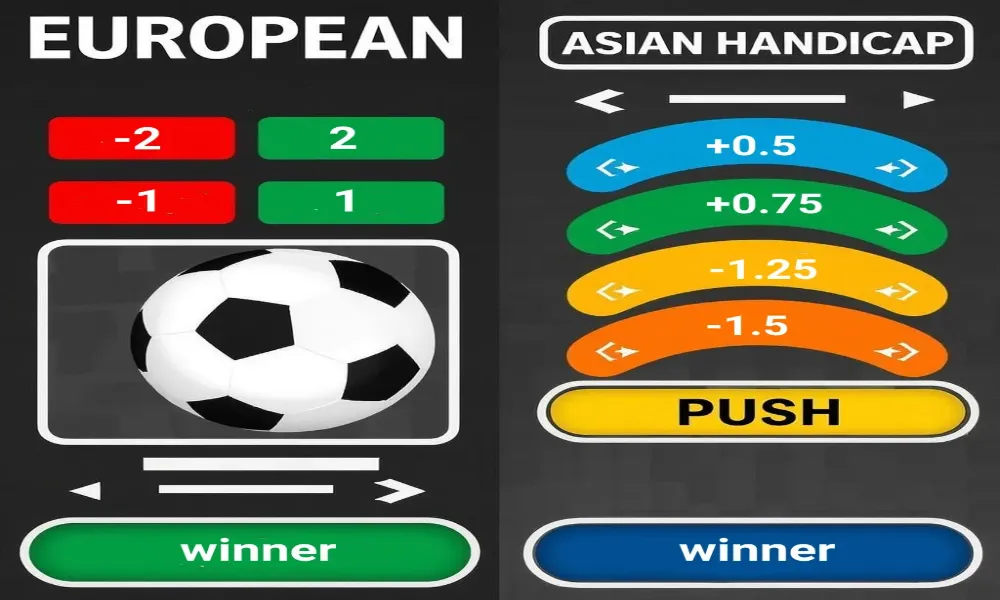
European handicap betting applies a virtual goal advantage or deficit to the final score. If you bet Bayern -1 on the European handicap, Bayern must win by two or more goals for your bet to succeed. If they win by exactly one goal, the handicap makes the final result a draw and you lose your bet. This is the crucial difference from Asian handicaps where some scenarios result in a push.
With European handicaps, there are always three possible outcomes: handicap home win, handicap draw, handicap away win. Your bet resolves to one of these three results after applying the handicap to the actual score. This structure means you can lose on the handicap draw even when your team wins the match.
European handicaps work best for backing heavy favorites where the straight moneyline offers no value. If Manchester City is -400 to beat a weak opponent, City -2 on the European handicap might be around -110. You're getting significantly better odds in exchange for requiring City to win by three or more goals. Whether this represents value depends on whether City's probability of covering -2 justifies those odds.
The handicap draw is where the bookmaker's edge often hides. When you bet Bayern -1 and they win by exactly one goal, you lose. This exact scoreline occurs frequently enough that it substantially reduces your win probability without being obvious to casual bettors who focus only on whether their team wins.
Asian Handicap
Asian handicaps eliminate the draw possibility by using half-goal or quarter-goal lines that make ties impossible. With Bayern -1.5, either Bayern covers by winning by two or more, or they fail to cover. There's no third outcome. This structure changes the math fundamentally compared to European handicaps.
Quarter-goal handicaps like -0.75 or -1.25 split your stake between two half-goal lines. Betting Real Madrid -0.75 means half your stake is on Madrid -0.5 and half is on Madrid -1. If Madrid wins by one goal, you win half your bet (the -0.5) and push half (the -1). This structure provides partial refunds in specific scenarios.
The zero handicap (often written as 0.0 or Pk for "pick'em") returns your stake if the match ends level. You're essentially betting draw no bet at whatever odds the zero handicap offers. This can sometimes provide better value than the explicitly labeled draw no bet market depending on how the bookmaker prices each.
Asian handicaps shine when backing favorites where you want better odds than the moneyline but aren't confident in covering large spreads. Manchester City -1.5 at -120 might offer better expected value than City moneyline at -300 if you believe City wins by two or more goals more than sixty percent of the time when they win.
Reading Asian handicap movements reveals sharp money. When a line opens at -1 and moves to -1.25, professional bettors are backing the favorite and the bookmaker is adjusting to balance their book. When a line moves the opposite direction, from -1 to -0.75, sharps are taking the underdog and forcing odds adjustments.
Goals Markets Decoded
Over/Under Totals
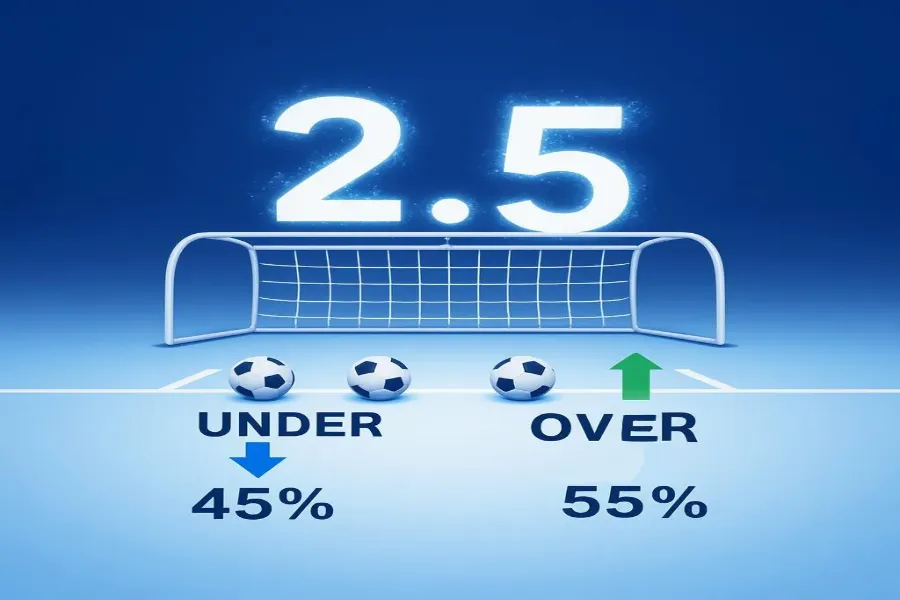
Over under betting predicts whether total goals scored will exceed or fall short of the bookmaker's line, typically 2.5 goals in Champions League matches. Over 2.5 wins with three or more total goals. Under 2.5 wins with two or fewer. The half-goal eliminates push scenarios.
Champions League matches produce lower scoring than domestic leagues because the quality of opposition is higher and tactical discipline matters more. A team that scores freely in their domestic league faces much stiffer defensive organization in Champions League knockout rounds. This context makes under bets more attractive than casual bettors expect.
Knockout stage first legs are particularly under-friendly. Neither team wants to concede away goals, leading to cautious tactical approaches that prioritize defensive solidity over attacking ambition. First legs routinely finish one-nil or one-one when the underlying team quality suggests higher scoring should occur.
The key to totals betting is assessing whether the line accurately reflects the specific matchup rather than relying on team scoring averages. Manchester City averages three goals per game in the Premier League but faces completely different defensive quality in a Champions League semifinal. Context-adjusted expectations matter more than raw statistics.
Live totals betting offers value when the first half produces fewer goals than expected but the underlying game dynamics suggest goals are coming. When an over 2.5 match sits nil-nil at halftime despite both teams creating chances, the adjusted total might offer value if the line hasn't moved enough to reflect that goals are likely in the second half.
Both Teams to Score
Both teams to score markets bet on whether each side finds the net at least once. This market ignores the final result—you win if the match ends two-one, one-one, three-two, or any other scoreline where both teams score. You lose if either team fails to score regardless of the margin of victory.
This market rewards analysis of defensive vulnerabilities more than overall team strength. A strong team with defensive weaknesses might be heavy favorites to win but still offer value on both teams to score if their opponent has any attacking quality. Liverpool's attacking prowess makes them favorites in most matches, but if their defense is compromised by injuries, both teams to score becomes more attractive than the match odds suggest.
Both teams to score trends strongly with specific team styles. Teams that play open, attacking football with weak defensive discipline are both teams to score magnets. Matches between these teams almost always see both sides scoring regardless of the final margin. Conversely, defensive teams that rarely concede make both teams to score no the smart bet even when facing opponents who score regularly.
The value proposition depends on whether the odds accurately reflect both teams' scoring probability. If Manchester City has ninety percent chance of scoring and their opponent has forty percent chance, the true probability of both teams scoring is around thirty-six percent. If the market is offering better than -180 on both teams to score, there might be value depending on your probability assessment.
Exact Score Betting
Exact score betting predicts the specific final scoreline. One-nil, two-one, three-zero, nil-nil—you're selecting one precise result from dozens of possibilities. The odds are long because predicting exact scores is extremely difficult, but the difficulty is exactly why this market sometimes offers value when you've identified scenarios with clear most-likely outcomes.
Certain scorelines cluster around specific tactical matchups. When a defensive underdog hosts a strong favorite, one-nil to the favorite is often the most likely individual outcome even though other scorelines remain possible. If the bookmaker is offering +600 on one-nil and your analysis suggests it occurs fifteen percent of the time, that's a positive expected value bet.
Nil-nil is chronically underbet by casual bettors who want to see goals and hate draws. This public bias creates value opportunities in matches where stalemate is actually the most likely individual result. First legs between evenly matched defensive teams might see nil-nil priced at +900 when it should be closer to +700 based on actual probability.
The challenge with exact score betting is that you need significant edges to overcome the long odds. Even if you're correctly identifying the most likely scoreline, if your probability assessment is only slightly better than the market's, the variance will destroy you over any reasonable sample size.
Player-Specific Markets
Goalscorer Props
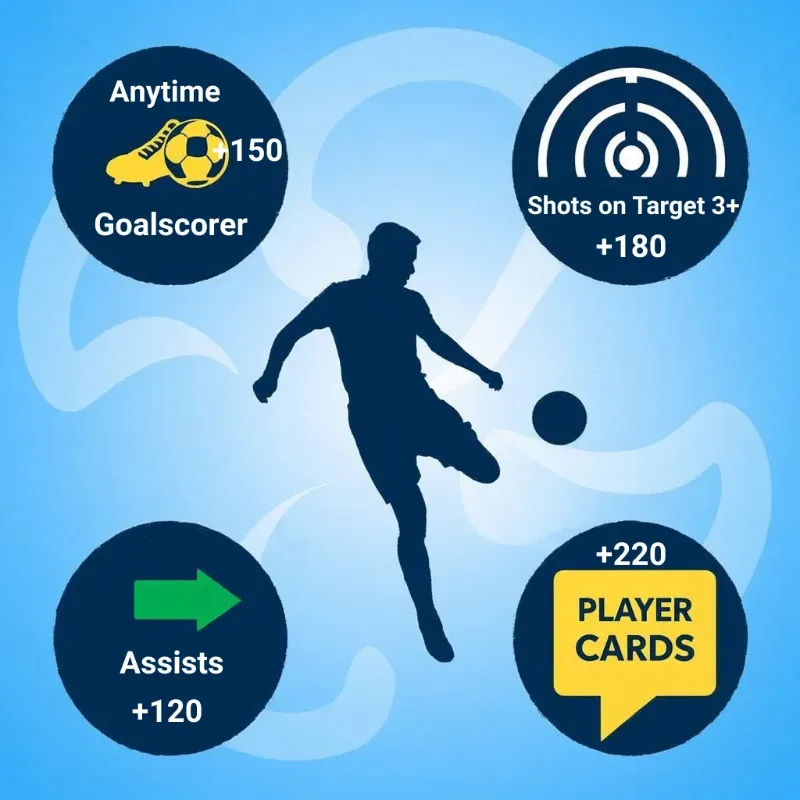
First goalscorer betting predicts which player scores the opening goal. If your selection scores first, you win regardless of what happens afterward. If someone else scores first, you lose even if your player goes on to score five goals. This market pays significantly better odds than anytime goalscorer but requires pinpoint accuracy about who scores specifically the first goal.
The math is brutal. In a match with forty potential first goalscorers spread across both teams, your selection needs to score first roughly one in forty times for break-even at typical odds around +1200. Even elite strikers playing for dominant teams score first less than ten percent of the time in any given match. This market is entertainment more than serious profit-seeking unless you have genuine edge on first goal probability.
Anytime goalscorer betting wins if your player scores at any point during the match. The odds are shorter than first goalscorer but your probability of winning is much higher. Elite strikers playing for attacking teams might be +150 to score anytime, implying roughly forty percent probability. If you assess their actual probability at fifty percent, that's significant value worth betting.
Player selection matters more than team selection for goalscorer props. The best striker on a mediocre team often offers better value than an average forward on an elite team because the odds don't fully account for individual quality differences. A world-class striker getting +200 to score anytime represents value even if their team is unlikely to win the match.
Minutes played is the hidden killer of goalscorer props. Your player needs to be on the pitch to score. If they get substituted at sixty minutes or sit on the bench until the seventy-fifth minute, your edge disappears regardless of their underlying scoring rate. Research team rotation patterns and manager tendencies before betting goalscorer props, especially in congested fixture schedules where rotation is likely.
Shots, Assists, and Cards
Shots markets bet on whether a player will register a certain number of shots during the match. Over 2.5 shots means your player needs at least three shot attempts. These markets favor attacking players on teams that dominate possession and create numerous opportunities.
Shots on target markets narrow the criteria to shots that require goalkeeper saves or find the net. This metric better reflects genuine scoring threats than total shots which include blocked efforts and wild attempts from distance. Players who combine high shot volume with good accuracy provide the best value on shots on target overs.
Player card markets bet on whether a specific player receives a yellow or red card during the match. Defensive midfielders who make frequent tactical fouls are prime candidates. Players with poor disciplinary records or reputations for losing their composure under pressure offer value when facing opponents who will frustrate them tactically.
The challenge with player props is that your selection needs to complete significant minutes. If your player gets injured in the twentieth minute or gets substituted at halftime, most of your betting edge disappears regardless of how well they were positioned to hit your prop.
In-Game Specific Markets
Half-Time Markets
Half-time result betting predicts the score at the forty-five minute mark—home win, draw, or away win at the break. These markets operate independently from full-time results. A team can be winning at halftime and losing at full-time, or vice versa.
Half-time betting rewards understanding team patterns. Some teams start slowly and build momentum. Others explode out of the gate and dominate early before tiring. If you've studied how teams typically perform across halves, half-time markets offer value opportunities that full-time markets don't.
Half-time over under markets predict whether goals in the first forty-five minutes will exceed or fall short of typically 0.5 or 1.5. Champions League first halves often see fewer goals than second halves as teams feel out opponents and adjust tactically. Under 1.5 first half goals is frequently the smart play.
Second Half and Time-Specific Markets
Second half betting operates like full-time betting but only counts what happens after halftime. Teams trailing at the break must attack in the second half, creating different dynamics than matches that start level. These adjusted motivations create value opportunities for bettors who can read game states.
Ten-minute interval markets bet on outcomes within specific time windows—whether a goal will be scored between twenty-one and thirty minutes, whether both teams will score in the final fifteen minutes, whether the next goal happens before or after the sixtieth minute. These niche markets offer long odds but require predicting match flow with precision that borders on guessing.
Statistical and Prop Markets
Corners Betting
Corner markets bet on total corners awarded during the match, typically with over under lines around 9.5 or 10.5 total corners. Teams that dominate possession and attack in wide areas generate corners consistently. Defensive teams that sit deep and absorb pressure concede corners but don't win many themselves.
Tactical matchups determine corner volumes. When a possession-dominant team faces an opponent that parks the bus, expect high corner counts as the attacking team probes for openings. When two possession teams meet, corners decrease because neither spends extended periods defending in their own box.
Corner handicaps work similarly to goal handicaps but applied to corners won. Manchester City -3.5 corners means City needs to win at least four more corners than their opponent for the bet to win. This market exploits situations where one team will dominate territory without necessarily winning by multiple goals.
Cards Markets
Total cards betting predicts how many yellow and red cards the referee will issue. Some officials are card-happy, maintaining tight control through frequent bookings. Others let matches flow physically and rarely reach for their pocket. Researching the assigned referee's card averages helps assess whether over under lines are fairly priced.
Player-specific card betting offers better edges than total cards because you can target players with poor disciplinary records facing opponents who will frustrate them. A combative midfielder with eight yellows already this season facing a technical team that draws fouls provides clear card risk.
Market Selection Strategy
Matching Markets to Analysis
Different analytical approaches suit different betting markets. If your strength is evaluating defensive organization and tactical discipline, under bets and clean sheet markets align with your expertise. If you excel at identifying attacking mismatches, goalscorer props and over bets leverage your analytical edge.
Don't force action on markets where you have minimal edge just because you want to bet the match. Sometimes the best bet is no bet. When your analysis doesn't produce clear conviction about any particular market, passing entirely is the disciplined choice even if watching the match feels less exciting without money on it.
Market efficiency varies across different bet types. Mainstream markets like match result and totals receive heavy action and sophisticated analysis from sharp bettors, making them harder to beat. Niche markets like corners and cards receive less attention and occasionally feature soft lines exploitable by specialists who focus on those markets exclusively.
Avoiding Sucker Bets
Certain Champions League markets exist primarily to separate casual bettors from their money. Accumulator bets combining multiple selections into one wager offer huge potential payouts but dramatically reduce your probability of winning. Each additional selection multiplies the difficulty and the bookmaker's edge compounds across all legs.
Exotic props like "goal scored from outside the box" or "penalty missed" or "manager sent off" feature odds that heavily favor the house. These events are rare enough and random enough that finding genuine edges is nearly impossible. They're entertainment bets, not serious profit-seeking opportunities.
Conclusion
Champions League betting markets offer dozens of ways to bet each match, but more options don't equal more profit opportunities. Understanding how each market works, when it offers value, and what mistakes to avoid separates sharp bettors from recreational gamblers.
Focus on markets where your analytical strengths align with what the market is asking you to predict. Specialize in bet types where you can develop genuine edges rather than spreading your attention across every available option. The bookmaker profits from bettors who can't resist action on every market—disciplined selectivity beats high-volume gambling.
Match your market selection to your analysis. Use your research to identify specific situations where particular bet types offer value, then have the discipline to pass on matches where no clear edge exists.
