
Champions League Betting Strategy: Advanced Techniques for Serious Bettors
 Available in US

After three years of breaking even on Champions League betting, I finally figured out what separated consistent winners from everyone else. It wasn't insider information or some magic system. It was treating betting like a business instead of entertainment—developing systematic approaches, tracking performance obsessively, and having the discipline to bet only when genuine edges existed rather than forcing action on every match.
The shift happened when I stopped asking "who will win this match" and started asking "does my assessment of probability differ meaningfully from what these odds imply?" That subtle reframing changed everything. Suddenly I was passing on matches where I correctly predicted the winner but the price offered no value. I was backing underdogs I expected to lose because the odds overcompensated for their actual chances. My win rate barely changed, but my profit margins exploded.
Advanced Champions League betting isn't about predicting outcomes with supernatural accuracy. It's about identifying small edges, exploiting them consistently, and managing risk so that variance doesn't destroy your bankroll before your edge manifests in profits. The difference between a fifty-two percent win rate and forty-eight percent is the difference between long-term profit and slow bankruptcy, and most of that difference comes from strategic thinking rather than analytical brilliance.
This guide is for bettors who've moved past basics and want to elevate their Champions League betting to a level where sustainable profit becomes realistic. We're discussing expected value calculations, building statistical models, exploiting market inefficiencies, and developing the psychological discipline required to execute strategies even when they're producing uncomfortable short-term results. If you're still figuring out what moneyline odds mean, this guide is premature—master the fundamentals first and come back when you're ready for advanced concepts.
The Champions League's structure creates exploitable patterns if you're sophisticated enough to identify them. The thirty-six team league phase produces different dynamics than knockout rounds. Early season matches when teams are still calibrating their approaches offer different opportunities than late season dead rubbers. Understanding these nuances and building systems to exploit them is what separates sharp bettors from the crowd.
Building a Champions League Betting Framework
Creating a Personal Methodology
Winning Champions League bettors don't approach matches randomly hoping to get lucky. They develop systematic frameworks for evaluating matches that produce consistent results over time. Your framework doesn't need to match anyone else's—it needs to work for you and match your strengths.
Start by defining what factors you consider most important for predicting Champions League outcomes. Some bettors prioritize expected goals and advanced metrics. Others focus on tactical matchups and coaching tendencies. Still others emphasize squad depth and fixture congestion. None of these approaches is objectively superior—what matters is identifying which analytical lens produces the most accurate predictions when you apply it.
Document your framework explicitly. Write down the factors you evaluate, how you weight them, and what thresholds trigger bets. This forces intellectual honesty and creates accountability. When your bets succeed or fail, you can review your framework and identify whether your reasoning was sound regardless of results. Over time, patterns emerge showing which elements of your analysis add genuine predictive value and which are noise.
The best frameworks are simple enough to execute consistently but sophisticated enough to capture meaningful edges. A framework with fifty variables becomes impossible to apply reliably. A framework with two variables probably misses important information. Finding the balance requires experimentation and continuous refinement based on your results.
Test your framework against historical data before risking real money. Pull Champions League results from past seasons and retrospectively apply your framework to see how it would have performed. This backtesting reveals obvious flaws before they cost you money. Just avoid overfitting—creating a framework that perfectly explains past results but has no predictive power for future matches.
Data Sources and Tools
Advanced Champions League betting requires access to quality data and the tools to analyze it efficiently. You can't compete with sharp bettors using only standings tables and basic match statistics. You need deeper information about team performance, player statistics, and tactical patterns.
Expected goals data from providers like StatsBomb, Opta, or free sources like FBref revolutionized soccer analysis by measuring shot quality instead of just counting attempts. A team creating high xG consistently is playing better than their results might indicate, and that gap between expected and actual performance tends to close over time. Incorporating xG into your analysis helps you identify teams due for regression either positively or negatively.

Tracking advanced metrics like progressive passes, pressures, and defensive actions provides insight into how teams actually play beyond what shows up in goal tallies. A team that progresses the ball effectively into dangerous areas will create chances even if their finishing is temporarily cold. A team conceding few shots might be getting lucky with opponent finishing rather than actually defending well.
Squad rotation tracking becomes crucial during congested fixture periods. Websites and Twitter accounts dedicated to lineup prediction help you anticipate when managers will rest players. Getting ahead of rotation before it's reflected in odds creates value opportunities that disappear once the information becomes public.
Video analysis tools let you watch specific sequences from matches to understand tactical patterns firsthand. Sometimes numbers miss context that becomes obvious watching how teams set up defensively or how specific players impact matches through positioning and movement that doesn't show up in statistics. Elite bettors combine quantitative data with qualitative observation.
Expected Value in Champions League Betting
What Is Expected Value
Expected value represents the theoretical long-term average outcome of a bet repeated infinitely. Positive expected value means you profit over time. Negative expected value means you lose over time. Understanding and calculating EV transforms betting from gambling into investment.
The formula is straightforward: multiply your win probability by potential profit, subtract your loss probability multiplied by your stake. If you bet ten dollars at +200 odds with a forty percent win probability, your EV equals (0.40 × twenty dollars profit) minus (0.60 × ten dollars stake) = eight dollars minus six dollars = plus two dollars expected value. This bet profits two dollars on average despite losing more often than winning.
Most bets carry negative expected value because bookmaker margins ensure the odds don't reflect true probability. When you see a coin flip priced at -110 on both heads and tails, that's negative EV—you're paying a ten percent tax to the bookmaker. Finding positive EV bets requires identifying situations where your probability assessment exceeds implied probability enough to overcome the bookmaker's margin.
The mathematical edge from a single positive EV bet is usually tiny—maybe two or three percent. But repeated across hundreds of bets, these small edges compound into substantial profits. A bettor consistently finding two percent edges and placing five hundred bets per season generates meaningful returns even with modest bankroll size.
Calculating EV requires honest assessment of your true win probability, which is harder than it sounds. Most bettors overestimate their predictive accuracy, leading them to believe negative EV bets offer positive value. The solution is tracking your predictions against actual results over large samples to calibrate your probability estimates.
Implied Probability and Finding Value
Bookmaker odds contain embedded probability assessments. Decimal odds of 2.00 imply fifty percent probability. Odds of 3.00 imply thirty-three percent probability. The formula is simple: divide one by the decimal odds to get implied probability.
American odds require different conversion. Positive odds like +200 convert to probability by dividing 100 by (odds + 100). So +200 equals 100 / (200 + 100) = 33.3 percent probability. Negative odds like -150 convert using odds / (odds + 100). So -150 equals 150 / (150 + 100) = 60 percent probability.
The key insight is that bookmaker margins mean the sum of implied probabilities exceeds one hundred percent. A match priced at -110 for both teams implies 52.4 percent probability for each side—a combined 104.8 percent. That extra 4.8 percent is the bookmaker's margin. Your assessment needs to exceed the implied probability by more than the margin to find genuine value.
Say you calculate a team has forty percent chance of winning but the odds imply only thirty percent. That ten percentage point gap represents significant value worth exploiting. Even if you're slightly wrong and the true probability is thirty-eight percent instead of forty percent, you're still getting value. The goal isn't perfect accuracy—it's directionally correct estimates that differ meaningfully from market prices.
Line Shopping for Maximum Value
Different bookmakers offer different odds on the same match. One might price Manchester City at -150 while another offers -140. That ten cent difference might seem trivial, but it compounds dramatically over hundreds of bets. Getting consistently better prices is worth significant long-term value.
Maintaining accounts with multiple bookmakers lets you always bet the best available price. The fifteen minutes spent checking odds across five different books pays for itself within weeks through accumulated better prices. Professional bettors consider line shopping non-negotiable—accepting inferior odds is voluntarily reducing your expected value.
Odds comparison websites aggregate prices across bookmakers, making line shopping efficient. You can instantly see who's offering the best price on any match without manually checking multiple sites. Some comparison tools even track line movement to show how odds have changed, revealing information about where sharp money is flowing.
The best odds aren't always at the same bookmaker. Smaller regional books sometimes offer superior prices on specific matches either through legitimate opinion differences or inefficient pricing models. Finding these inefficiencies requires effort but delivers consistent value edges that add up substantially over full seasons.
Statistical Modeling for Champions League
Building Predictive Models
Statistical models use historical data to generate probability estimates for match outcomes. Basic models might use recent form and head-to-head records. Sophisticated models incorporate dozens of variables weighted through regression analysis to identify which factors best predict results.
Expected goals models predict future goal-scoring by analyzing shot quality and quantity. Teams consistently generating high xG will likely score more goals than their current tally suggests, while teams overperforming xG are due for negative regression. Building or accessing quality xG models gives you probability assessments grounded in underlying performance rather than noisy short-term results.
Poisson distribution models estimate goal probabilities based on attacking and defensive strength ratings. By calculating expected goals scored and conceded for each team, you can generate probability distributions for every possible scoreline. Summing relevant scorelines gives you win, draw, and loss probabilities to compare against bookmaker odds.
Elo rating systems adapted for soccer provide dynamic team strength ratings that update after every match. Starting with base ratings and adjusting based on match results weighted by importance, Elo generates strength assessments that convert into match win probabilities. Several public soccer Elo models exist that you can reference or build your own custom version.
The challenge with any model is avoiding overfitting—creating something that explains past data perfectly but has no predictive power. Test your models against out-of-sample data they weren't trained on. If performance degrades significantly, you've overfit. Simpler models with fewer variables often predict better than complex models despite explaining less historical variance.
Incorporating Contextual Factors
Raw statistics miss crucial context that affects match outcomes. A team's underlying numbers might suggest strength, but if they're playing their fifth match in fifteen days with key players injured, their true win probability is lower than models indicate.
Fixture congestion impacts performance significantly but doesn't appear in most statistical models. Teams playing Champions League midweek then domestic league matches on weekends with minimal rest underperform their typical levels. Identifying which teams face heaviest scheduling burden creates value when betting against them in congested periods.
Motivation matters enormously in Champions League. A team already qualified for knockout rounds with group standing locked in will likely rotate heavily and play with less intensity than models suggest. Conversely, teams needing a result for qualification play above their typical level. Adjusting model outputs for motivational context improves prediction accuracy.
Tactical matchups create specific advantages not captured by general strength ratings. A team that dominates possession faces challenges against compact defensive opponents who counter-attack. A high-pressing team might struggle against opponents skilled at playing through pressure. Understanding these tactical dynamics lets you adjust model predictions for specific matchup contexts.
Model Maintenance and Iteration
Models degrade over time as the game evolves. Tactical trends shift, rules change, and what predicted outcomes three years ago might be less predictive today. Regular model maintenance—updating data, reassessing variable weights, and testing current predictive accuracy—prevents obsolescence.
Track your model's performance continuously. Compare predicted probabilities against actual results. If your model says teams with sixty percent win probability are only winning fifty-five percent of the time, recalibration is necessary. Honest performance tracking reveals when models need adjustment.
Avoid constantly tinkering with models based on recent results. Small sample variance will tempt you to adjust models after every bad week. But making changes based on noise rather than signal degrades predictive accuracy. Only adjust models when you've accumulated sufficient evidence that something fundamental has changed or your methodology was flawed.
Market Analysis and Line Movement
Understanding Market Efficiency
Betting markets aggregate information from thousands of bettors with diverse information sources and analytical approaches. This collective wisdom often produces remarkably accurate probability estimates—more accurate than most individual predictions. Understanding market efficiency prevents you from betting against consensus without strong justification.
Markets are most efficient for high-profile matches attracting heavy betting volume. When hundreds of thousands of dollars flow into a Barcelona versus Bayern Munich Champions League match, the collective betting patterns quickly correct any initial pricing inefficiencies. Finding value in these liquid markets requires either superior information or analytical edges.
Lower-profile matches or markets with limited liquidity remain inefficient longer. Lesser-known team matchups in early group stages attract less sophisticated betting activity, creating more exploitable pricing errors. These matches offer better opportunities for skilled bettors because you're competing against less sharp overall action.
The closing line—the odds available right before kickoff—represents the market's most efficient price after absorbing all available information and betting patterns. If you consistently get better odds than the closing line (positive closing line value), you're likely finding genuine edges even if your bets don't all win. Conversely, if you consistently bet worse than closing odds, you're fighting an uphill battle.
Reading Line Movement
Odds change between opening and kickoff based on betting patterns and new information. Reading line movement reveals where sharp money is flowing and what information is affecting market prices. Understanding these patterns helps you time your bets optimally and identify which side of matches professional bettors favor.
Sharp money refers to bets from sophisticated professional bettors whose action bookmakers respect. When a line moves toward one side despite betting volume favoring the other, it suggests sharp money backing the side receiving favorable line movement. Bookmakers shade odds toward sharp positions even if it creates liability because sharp bettors win long-term.
Reverse line movement occurs when odds move opposite to betting percentages. If seventy percent of bets back Real Madrid but their odds lengthen rather than shorten, sharp money is on the other side. Bookmakers are more concerned about sharp action than public betting volume. Following reverse line movement often leads you to the same positions as professional bettors.
Steam moves are sudden dramatic line movements driven by coordinated sharp betting. Multiple professional bettors simultaneously betting the same position forces bookmakers to rapidly adjust odds to manage liability. Identifying steam moves quickly lets you get on the right side of the move, though timing is crucial—you want to bet before the full adjustment occurs.
Timing Your Bets
When you place bets affects the value you receive. Early odds often contain more inefficiencies before markets fully incorporate all available information. But waiting closer to kickoff lets you account for late-breaking lineup news and weather changes. Finding the optimal timing balance requires considering which factors matter most for specific matches.
Betting immediately when lines are released exploits bookmakers before they've fully calibrated prices. Early odds sometimes miss obvious factors that cause line movement once bettors identify the oversight. If you spot these inefficiencies quickly, you capture value before the market corrects.
The risk of early betting is that you've committed your stake before lineup announcements. If a key player suffers an injury in training the day before the match, you're locked into odds that no longer reflect actual probabilities. For matches where specific player availability significantly impacts outcomes, waiting until confirmed lineups makes sense even if you sacrifice some closing line value.
For matches where you have strong conviction and don't expect material late-breaking information, betting earlier captures better prices before sharp money moves the line. For matches involving injury-prone key players or managers who heavily rotate, waiting for lineup confirmation prevents costly bad beats from unexpected absences.
Psychological Discipline in Betting
Common Cognitive Biases
Human brains evolved for survival, not optimal betting decisions. We're hardwired with cognitive biases that sabotage rational analysis. Understanding these mental traps is crucial for maintaining discipline and avoiding systematic errors.
Recency bias overweights recent events in your assessment. A team's dominant performance last week feels more relevant than their mediocre form over the previous month. But single matches are noisy data points—broader trends predict future performance better than isolated recent results.
Confirmation bias makes you seek information supporting your existing beliefs while dismissing contradictory evidence. If you want to bet Liverpool, you'll find reasons Liverpool should win and ignore warning signs suggesting otherwise. This selective attention produces overconfident bets on positions you're emotionally invested in.

The gambler's fallacy convinces you that past results influence future independent events. Your favorite team has lost three straight matches, so you're convinced they're "due" for a win. But each match is an independent event—their probability of winning the next match hasn't changed just because they lost recently.
Combating these biases requires systematic analysis that forces you to consider contradictory evidence. Keep a written record of your reasoning for every bet. Write down factors suggesting both sides should win. This intellectual discipline counteracts your brain's tendency toward confirmation bias and emotional reasoning.
Dealing With Variance
Variance is the statistical reality that short-term results will deviate from long-term expectation, sometimes dramatically. You can make every bet with positive expected value and still experience brutal losing streaks purely through bad luck. Understanding this prevents emotional overreactions to inevitable downswings.
A betting strategy with fifty-five percent win probability will still experience stretches of ten losses in fifteen bets. These downswings feel terrible and trigger doubt about whether your system works. But they're mathematically expected over large samples—variance doesn't mean your edge disappeared, it means random distribution is doing what random distribution does.
Maintaining discipline during downswings separates successful bettors from the crowd. Most people respond to losing streaks by either abandoning their strategy, increasing bet sizes to chase losses, or making desperate bets on matches they haven't properly analyzed. All three responses guarantee long-term failure.
The solution is trusting your process and accepting that variance is part of gambling. If your analysis is sound and you're finding positive EV bets, short-term results are irrelevant noise. What matters is whether your closing line value remains strong and your decision-making process stays disciplined.
Tracking your performance across hundreds or thousands of bets reveals whether you actually have an edge or you've just been lucky. Twenty winning bets proves nothing. Two hundred winning bets at positive expected value suggests genuine skill.
Advanced Bankroll Management Strategies
Kelly Criterion for Bet Sizing
The Kelly Criterion provides a mathematical formula for optimal bet sizing based on your edge and odds. The formula determines what percentage of your bankroll to risk on each bet to maximize long-term growth while minimizing bankruptcy risk.
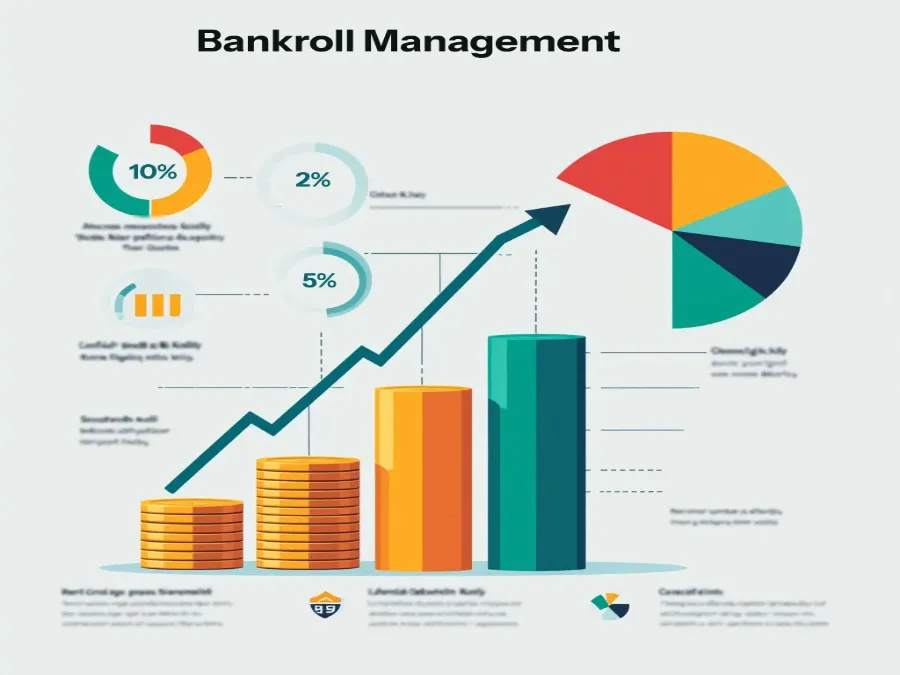
Kelly equals (odds times win probability minus loss probability) divided by odds. If you've got a fifty-five percent win probability at even money, Kelly suggests betting ten percent of your bankroll. That seems aggressive, and most professional bettors use fractional Kelly—betting a fraction of the Kelly-calculated amount to reduce variance.
Half Kelly bets half the suggested amount, which dramatically reduces variance while still capturing substantial expected growth. Quarter Kelly is even more conservative. The tradeoff is slower bankroll growth in exchange for smoother results and reduced risk of catastrophic drawdowns during inevitable losing streaks.
The challenge with Kelly is accurately assessing your win probability. The formula is only useful if your probability estimates are accurate. Overestimating your edge leads to overbetting and potential ruin. Most bettors overestimate their skill, making conservative fractional Kelly approaches safer for practical application.
Scaling Stakes With Bankroll Growth
As your bankroll grows through successful betting, your absolute bet sizes should increase proportionally. If you started with one thousand dollars betting twenty dollars per bet (two percent of bankroll), and you've grown to two thousand dollars, your new bet size should be forty dollars to maintain the same two percent exposure.
This scaling ensures you're capitalizing on your success by increasing risk proportional to your growing capital base. Keeping bet sizes constant as your bankroll grows means you're becoming increasingly conservative and not maximizing your edge.
Conversely, if your bankroll shrinks through a losing streak, reduce your bet sizes proportionally. If you drop from one thousand dollars to seven hundred dollars, your twenty-dollar bets should shrink to fourteen dollars. This prevents accelerating losses during downswings by maintaining consistent percentage-based risk management.
Tournament-Long Betting Strategies
Champions League futures markets let you bet on tournament outcomes before they're determined. Betting Real Madrid to win the tournament at +800 in September creates a position you can manage over nine months as the competition unfolds.
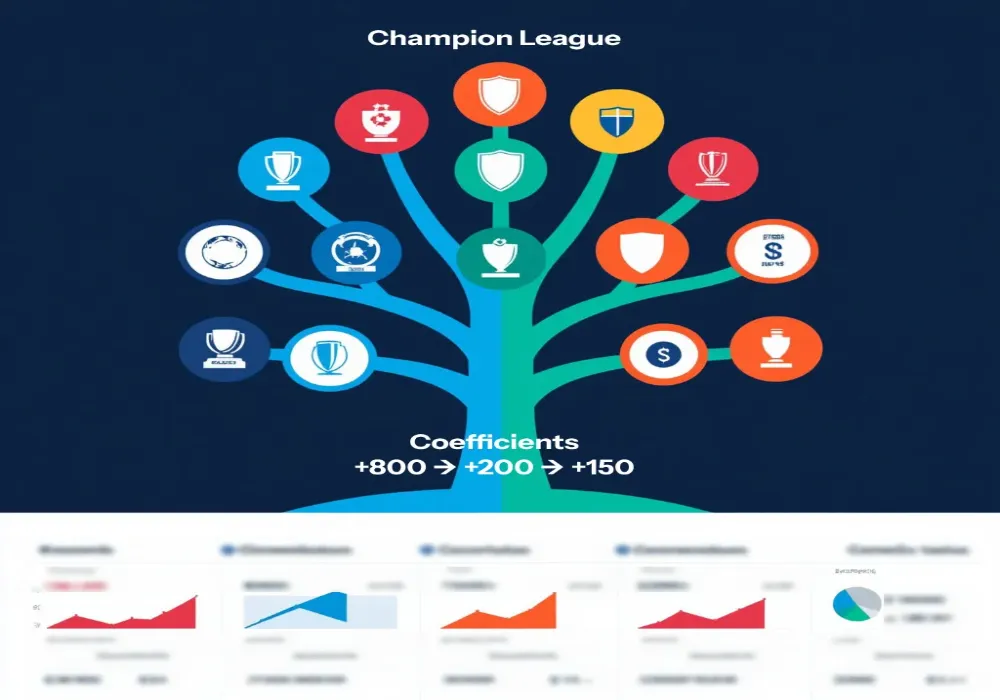
The advantage of futures betting is securing odds before they shorten. If Madrid reaches the semifinals and their odds drop to +200, you got dramatically better value by betting early. The disadvantage is your money is tied up for months and you can't react to injuries or form changes that alter your assessment.
Hedging futures positions becomes viable when your original bet gains significant value. If you backed Liverpool at +1200 to win the tournament and they reach the final as favorites, you can hedge by betting their opponent. This locks in guaranteed profit regardless of final result.
Tournament progression creates evolving value. A team you faded in September might become attractive in January after a favorable draw or unexpected form. Conversely, your pre-tournament favorite might be worth trading out of if they've struggled or face brutal upcoming fixtures.
Conclusion
Advanced Champions League betting demands treating it like a business—systematic analysis, disciplined execution, and honest evaluation of results. Expected value thinking, statistical modeling, and psychological discipline separate professionals from recreational gamblers.
Build frameworks that exploit your analytical strengths. Track performance obsessively to identify what works and what doesn't. Accept that variance will produce frustrating losing streaks that test your discipline. The Champions League rewards bettors who combine analytical sophistication with emotional control and bankroll management discipline.
