
How to Bet on Champions League: Step-by-Step Guide for Beginners
 Available in US

I placed my first Champions League bet in 2017, and it was a complete disaster. Liverpool versus Spartak Moscow, and I was convinced Liverpool would destroy them based on nothing more than knowing Liverpool had better players. I bet fifty dollars on Liverpool at -300 without understanding what those odds meant, without checking if key players were injured, without even confirming the match was being played at Anfield. Liverpool won one-one at Spartak, my bet lost, and I learned an expensive lesson about doing basic research before gambling real money.
That embarrassing introduction to Champions League betting taught me something crucial: this isn't a competition you can approach casually and expect to win. The matches are complex, the tactical approaches vary wildly between domestic and European football, and bookmakers are sophisticated operations that don't give away free money to bettors who haven't done their homework.
But here's the good news—Champions League betting is absolutely perfect for beginners willing to learn properly. The tournament structure is straightforward once you understand it. The betting markets are clearly defined. Information about teams, players, and tactical approaches is freely available if you know where to look. And unlike some niche sports where betting information is scarce, Champions League coverage is exhaustive because it's one of the most popular sports competitions on the planet.
This guide walks you through everything you need to know to place your first Champions League bet without making the mistakes I made. We're starting from absolute zero—explaining what the Champions League actually is, how to choose a trustworthy sportsbook, what different bet types mean, and most importantly, how to avoid the traps that catch new bettors. No assumptions about prior knowledge, no skipping the fundamentals, just a clear roadmap from complete beginner to someone who can confidently place educated bets on Champions League matches.
The goal isn't to turn you into a professional bettor overnight. It's to give you the tools to engage with Champions League football in a way that's fun, informed, and financially responsible. Betting should enhance your enjoyment of elite football, not create stress or financial problems. Master these basics first, and you'll be positioned to develop more advanced strategies as your experience grows.
Champions League Betting Basics for Newcomers
What Is the Champions League
The Champions League is European club football's premier competition, featuring the best teams from across the continent competing over nine months for the title of European champion. Think of it as the World Cup but for professional clubs instead of national teams, and it happens every single year.
Thirty-six teams qualify based on their performance in their respective domestic leagues. Teams from England's Premier League, Spain's La Liga, Germany's Bundesliga, Italy's Serie A, and France's Ligue 1 form the core, along with clubs from smaller European leagues who earn their spots through qualifying rounds. The bigger and more successful your domestic league, the more teams you get to send to the Champions League.
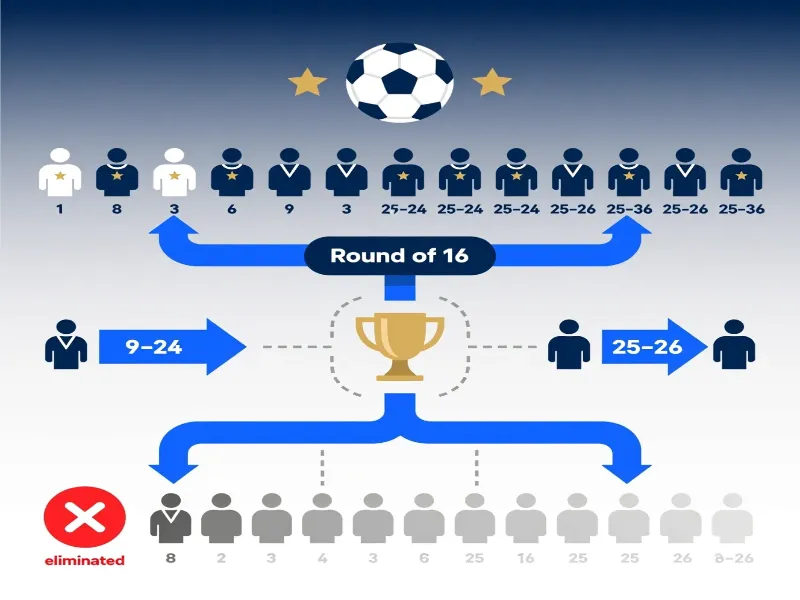
The tournament starts with a league phase where all thirty-six teams compete in a single table. Each team plays eight matches against different opponents—four at home, four away. The top eight teams advance directly to the Round of 16. Teams finishing ninth through twenty-fourth enter a playoff round to compete for the remaining eight spots. Everyone else goes home.
After the league phase comes knockout rounds—Round of 16, quarterfinals, semifinals, and the final. These are two-legged ties where teams play home and away, with the aggregate score determining who advances. If the aggregate is level after both legs, the match goes to extra time and potentially penalties. The final is a single match at a neutral venue where the champion is crowned.
This structure matters for betting because different phases produce different tactical approaches. League phase matches feature more attacking football as teams hunt for points. Knockout rounds become more cautious as the stakes increase and one mistake can end your entire season. Understanding these dynamics helps you make smarter bets.
Why Champions League Betting Is Different
If you've bet on NFL games or NBA matches, Champions League betting will feel familiar in some ways and completely foreign in others. The basic concept is the same—you're predicting outcomes and risking money on those predictions. But the specifics of how Champions League matches unfold create unique betting considerations.
The draw option changes everything. In American sports, ties are rare or impossible. Basketball games play overtime until someone wins. Football has overtime rules. But soccer matches can end level, and in Champions League betting, that draw is one of your three possible outcomes for most bets. This three-way market means your favorite can dominate possession, create more chances, and still not win if the match ends one-one.
Champions League matches happen midweek—Tuesdays and Wednesdays typically. This timing matters because it falls between weekend league fixtures, which affects how managers approach team selection. A club with a crucial Premier League match on Sunday might rest key players for their Wednesday Champions League fixture if they're already qualified or eliminated. This rotation risk is something you need to account for when betting.
The quality level is remarkably high and consistent. In domestic leagues, you get massive gaps between the best and worst teams. Champions League filters for quality—even the "worst" teams in the competition are league champions from their countries or finished in the top positions in elite leagues. This compressed quality gap makes upsets more common and favorites less reliable than you might expect.
Refereeing differences matter more than in domestic competitions. Each match might feature a referee from a different country with different standards for what constitutes a foul, how physical play is allowed, and when cards get issued. These subtle variations affect match flow and outcomes in ways that aren't obvious until you've watched enough European football to recognize the patterns.
Choosing Your First Sportsbook
What to Look for in a Betting Site
Not all sportsbooks are created equal, and where you place your first Champions League bets matters more than most beginners realize. The right sportsbook makes betting straightforward and secure. The wrong one creates headaches that can ruin your entire experience.
Licensing and regulation should be your first concern. Stick with sportsbooks licensed by established gaming commissions in legitimate jurisdictions—UK Gambling Commission, Malta Gaming Authority, or state gaming boards in the US. These licenses mean the sportsbook is held to standards about fair play, financial security, and responsible gambling. Unlicensed offshore books might offer attractive bonuses but they've been known to stall withdrawals or simply disappear with customer money.
User interface quality determines whether betting is enjoyable or frustrating. A good sportsbook makes it easy to find Champions League matches, understand your betting options, and place wagers without confusion. Poor interfaces bury important information, make navigation difficult, and increase the chances you'll accidentally place the wrong bet. Before depositing money, explore the site's Champions League section to verify you can understand how everything works.
Champions League coverage depth varies significantly between books. Some offer hundreds of betting markets per match—team to score first, correct score, half-time result, player props. Others stick to basics like match result and over under goals. Beginners don't need exotic markets initially, but you want a book that offers variety as you gain experience.
Payment options matter for convenience and speed. Good sportsbooks offer multiple deposit methods—credit cards, debit cards, e-wallets like PayPal or Skrill, and sometimes cryptocurrency. Withdrawal options should be equally diverse. Check processing times too—some books pay out within hours, others take days, and a few take weeks.
Customer service quality becomes critical when problems arise. Test the support before depositing by asking a simple question through live chat or email. Quick, helpful responses suggest a sportsbook that values customers. Slow, unhelpful replies or no response at all warns of potential issues when you need assistance with deposits, withdrawals, or bet disputes.
Understanding Odds Formats
Sportsbooks display odds in different formats depending on your location, and understanding these formats is essential for making informed bets and calculating potential returns.
American odds use plus and minus signs. Negative odds like -150 indicate the favorite and show how much you need to bet to win one hundred dollars. Positive odds like +200 indicate the underdog and show how much you win if you bet one hundred dollars. American odds are standard in the United States.
Decimal odds are popular in Europe, Australia, and Canada. They show your total return including your stake. Odds of 2.50 mean a one hundred dollar bet returns two hundred fifty dollars—one hundred fifty dollars profit plus your one hundred dollar stake back. Decimal odds are straightforward once you understand they include your original stake.
Fractional odds are traditional in the UK and Ireland. Odds of 3/1 (three to one) mean you win three dollars for every one dollar bet, plus your stake back. These fractions represent profit only, not total return like decimal odds.
Most sportsbooks let you choose your preferred odds format in settings. Pick whichever makes intuitive sense to you—the underlying probabilities and payouts are identical regardless of display format.
Basic Champions League Bet Types
Match Result (1X2)
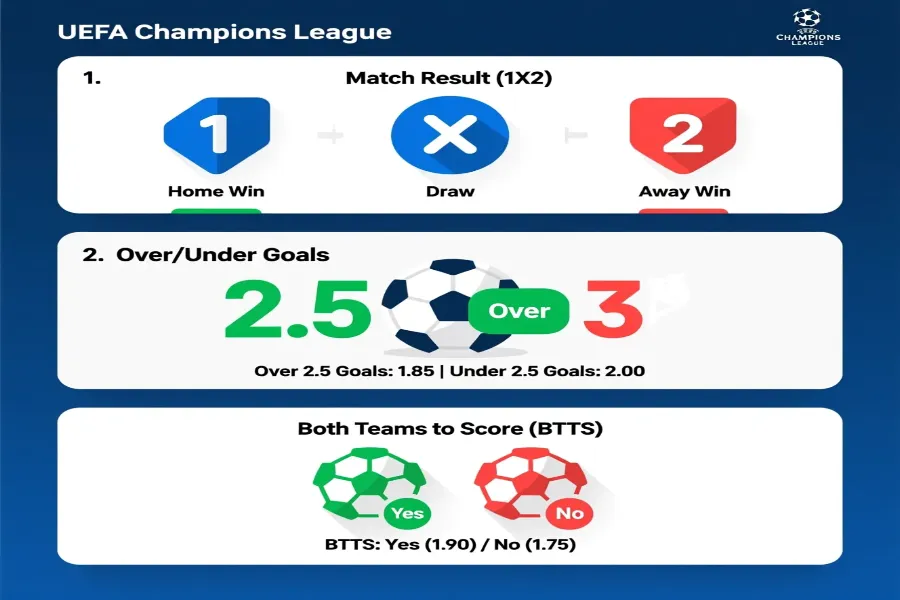
The match result bet is the simplest and most popular Champions League wager. You're betting on the outcome after ninety minutes—home win, draw, or away win. This is sometimes called a 1X2 bet, where 1 represents home win, X represents draw, and 2 represents away win.
When Manchester City plays Napoli at the Etihad, you have three betting options. Back City to win if you think they'll secure victory. Back the draw if you expect a level result. Back Napoli to win if you believe they'll pull off an upset. Only one outcome wins your bet—the other two lose.
This three-way market exists because soccer matches can end level. Unlike basketball or American football where ties are rare or impossible, draws are common in European football. Roughly twenty-five percent of matches across major leagues end level, though Champions League knockout rounds see fewer draws than league phase matches due to tactical approaches.
Understanding when draws become more likely improves your betting. Late-stage matches between evenly matched teams often produce cautious football and level results. Early matches where both teams need points see more attacking play and decisive outcomes.
Over Under Goals
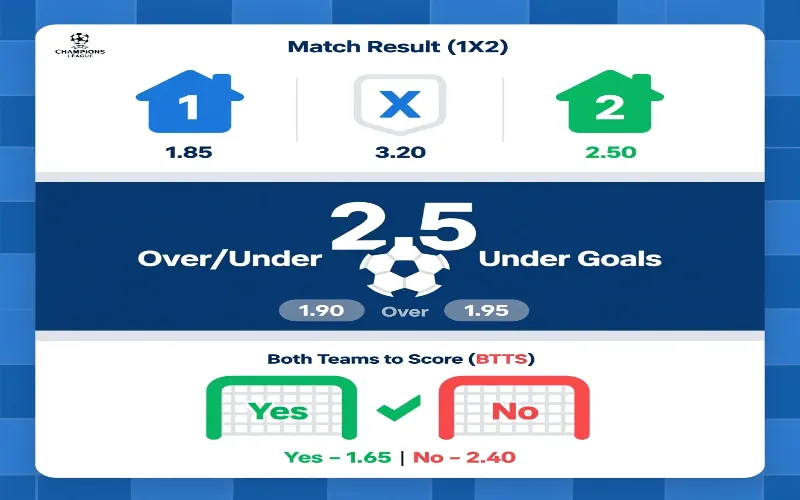
Over under betting predicts whether total goals scored will exceed or fall below a number set by the sportsbook. The most common line is 2.5 goals. Bet over 2.5 and you're predicting three or more goals. Bet under 2.5 and you're predicting two or fewer goals.
This bet doesn't care who wins—only total goals matter. A three-zero victory, a two-one result, and a one-two defeat all hit over 2.5 goals. A zero-zero draw, a one-zero win, and a one-one tie all hit under 2.5 goals.
The .5 in the line eliminates draws. With 2.5 goals as the line, the match either goes over or under—it can't land exactly on 2.5. Some sportsbooks offer whole number lines like 2 or 3 goals, which can result in pushes where your stake is returned if the total matches exactly.
Different matchups produce different goal expectations. When Bayern Munich plays an aggressive attacking team, over 2.5 might be priced at -120 because both teams score frequently. When Atletico Madrid faces Inter Milan, two defensively solid teams, under 2.5 might be heavily favored due to their conservative playing styles.
Research team statistics before betting totals. Look at average goals scored and conceded per match. Check recent form—are they in a goal-scoring run or struggling to create chances? Home and away splits matter too since some teams score more at home but tighten up on the road.
Both Teams to Score
This straightforward market asks a simple question—will both teams score at least one goal? Yes if both teams find the net, no if one or both teams fail to score. The final score doesn't matter beyond whether each team scored.
Both teams to score yes wins with final results like two-one, three-two, one-one, or even four-three. It loses with zero-zero, one-zero, two-zero, or any scoreline where one team blanks. Both teams to score no is the opposite—you're betting at least one team doesn't score.
This bet appeals when you expect an open, attacking match but aren't confident predicting the winner. It's also useful in Champions League matches where both teams have strong attacks but questionable defenses.
Analyze both teams' attacking and defensive records. A team that scores in ninety percent of matches but also concedes regularly makes both teams to score yes attractive. Teams with elite defenses who regularly keep clean sheets push you toward both teams to score no.
Tactical approaches matter significantly. If one team plans to defend deep and counter-attack, they might not create enough chances to score even if their opponent dominates possession. Both teams to score no becomes more appealing in these mismatched tactical scenarios.
Double Chance
Double chance markets let you cover two of the three possible outcomes with a single bet. You can bet home win or draw, away win or draw, or home win or away win. Two of three outcomes result in your bet winning, which reduces risk but also reduces potential profit through shorter odds.
This market appeals to beginners who are confident a favorite won't lose but aren't sure they'll win. Backing Manchester City or draw means your bet wins if City wins or if the match ends level—only a Napoli victory loses your bet. The price reflects this reduced risk, offering smaller potential returns than backing City straight up.
Double chance is particularly useful in Champions League knockout rounds where favorites might play conservatively for a draw knowing they can win the second leg at home. It gives you safety while still allowing you to back quality teams.
How to Research Champions League Bets

Successful Champions League betting starts with proper research, but beginners often don't know where to find reliable information or what factors actually matter for predicting outcomes.
Check team news and lineups before betting. Injuries to key players dramatically affect match outcomes, and Champions League rotation means starters aren't always guaranteed to play. Official club websites and reputable football news sites publish injury updates and expected lineups in the days leading up to matches.
Recent form matters but requires context. Look beyond just wins and losses to understand how teams are actually playing. Did they win because they dominated or got lucky with a last-minute goal? Did they lose despite playing well and creating chances? These nuances reveal more than simple result tables.
Head-to-head records between teams show tactical matchups and psychological edges. Some teams consistently struggle against specific opponents regardless of current form. If Liverpool has lost their last three matches against Real Madrid, that pattern suggests something about the tactical matchup worth considering.
Home and away form splits are crucial in Champions League. Some teams are formidable at home but struggle on the road. Others travel well but don't protect their home advantage. Check how each team performs in home versus away fixtures before betting.
Statistical websites provide free access to detailed metrics—shots, possession, expected goals, defensive records. These numbers help you evaluate team quality beyond subjective impressions. A team might be winning ugly with unsustainable luck, or losing despite strong underlying performance.
Bankroll Management for Beginners

The fastest way to fail at Champions League betting is betting more than you can afford to lose. Proper bankroll management isn't exciting, but it's what keeps you in the game long enough to develop skills and potentially profit.
Set aside a specific amount as your betting bankroll—money you can afford to lose completely without impacting your life. This isn't rent money or grocery money. It's entertainment budget that you're comfortable risking. For most beginners, this might be anywhere from one hundred to five hundred dollars.
Never risk more than one to five percent of your bankroll on any single bet. If your bankroll is two hundred dollars, your maximum single bet should be four to ten dollars. This conservative approach protects you from devastating losing streaks that wipe out your entire bankroll in a few bad bets.
As your bankroll grows through winning bets, your unit size grows proportionally. If you start with two hundred dollars betting four dollars per bet, and you grow your bankroll to three hundred dollars, your new unit size becomes six dollars. This scales your risk appropriately as your success continues.
Track every bet you place in a simple spreadsheet. Record the date, match, bet type, stake, odds, and result. This creates accountability and lets you analyze your performance over time. You might discover you're profitable betting unders but losing money on favorites, which tells you where to focus your energy.
Never chase losses by increasing your bet size after losing streaks. The temptation to "win it all back" with one big bet is how recreational bettors destroy their bankrolls. Stick to your unit size regardless of recent results.
Common Mistakes to Avoid
New Champions League bettors make predictable mistakes that cost them money. Learning to avoid these traps improves your results immediately without requiring sophisticated analysis or experience.
Betting on your favorite team destroys objectivity. Emotional attachment blinds you to obvious flaws and makes you overvalue their chances. If you can't bet against your team when the numbers say you should, don't bet on matches involving them at all.
Parlays tempt beginners with huge potential payouts but they're profit killers long-term. Combining multiple bets into one wager requires every selection to win, which dramatically reduces your probability of success. Stick to single bets until you've proven you can win money consistently.
Ignoring rotation risk in busy periods costs bettors constantly. December and January see clubs playing twice weekly while managing injuries and suspensions. Verify expected lineups before betting or you'll back teams fielding reserve squads.
Betting without checking odds across multiple sportsbooks leaves money on the table. Different books offer different prices on the same matches. Always taking the best available odds compounds into significant profit over dozens of bets.
Chasing losses by increasing stakes after bad beats is the fastest path to bankruptcy. Accept that losing streaks happen and maintain discipline with your unit sizing regardless of recent results.
Conclusion
Champions League betting isn't complicated once you understand the fundamentals. Choose a licensed sportsbook, start with simple bet types like match results and over under goals, research matches properly before betting, and manage your bankroll conservatively.
Your first bets should be small stakes on matches you've researched thoroughly. Focus on learning how Champions League matches unfold tactically rather than chasing big payouts. Experience teaches you patterns that no guide can fully convey.
The tournament runs from September through May, giving you dozens of matches to practice on. Start conservatively, track your results honestly, and adjust your approach based on what the data tells you about your strengths and weaknesses as a bettor.
