
Terminology Glossary
 Available in US

Sports betting developed its own vocabulary over decades, borrowing terms from gambling houses, horse racing tracks, and street bookies before evolving into the regulated digital industry we know today. Walking into Champions League betting without understanding this language is like showing up to a negotiation without speaking the local dialect – you’ll miss crucial nuances and probably make expensive mistakes. This glossary covers the essential terminology every Champions League bettor needs, from fundamental concepts to market-specific jargon.
Core Betting Concepts
Action refers to any bet or wager. When you place a bet, you’re taking action. A match with heavy action is receiving substantial betting volume. The term originated in gambling contexts where any monetary activity was simply called “action.”
Bankroll is the total amount of money you’ve set aside specifically for betting. This isn’t your checking account or savings – it’s a segregated fund designated for wagering that you can afford to lose entirely. Serious bettors treat bankroll management as fundamental to their approach.
Chalk describes the favorite in any betting market. Betting the chalk means backing the favorite. The term comes from old bookmaking practices where odds were written in chalk on boards, with favorites prominently displayed.
Cover means to beat the point spread. If you back Liverpool -1.5 and they win 2-0, Liverpool covered. If they win 1-0, they failed to cover. The term applies specifically to spread betting rather than moneyline outcomes.
Edge represents any advantage a bettor holds over the bookmaker’s odds. Finding edge means identifying situations where your assessment of probability exceeds what the odds imply. Sustainable betting profitability requires consistently finding edge.
Handle is the total amount of money wagered on a particular event or across a sportsbook’s entire operation. A Champions League final might generate a handle of hundreds of millions across global betting markets.
Limit is the maximum bet a sportsbook will accept on a particular market. Sharp bettors who consistently win often face reduced limits, while recreational bettors can typically bet up to posted limits without restriction.
Sharp describes a professional or highly skilled bettor whose wagers bookmakers respect and sometimes follow. Sharp action moves lines because bookmakers believe these bettors have edge. The opposite of a sharp is a “square” – a recreational or unsophisticated bettor.
Square refers to casual bettors who bet recreationally rather than professionally. Squares tend to bet on favorites, popular teams, and high-profile matches without deep analysis. Bookmakers profit primarily from square action.
Unit is a standardized bet size representing a percentage of your bankroll. If your unit is 50 dollars, saying you bet “two units” means a 100-dollar wager. Using units rather than absolute amounts allows bettors with different bankrolls to discuss strategy meaningfully.
Odds and Pricing Terminology
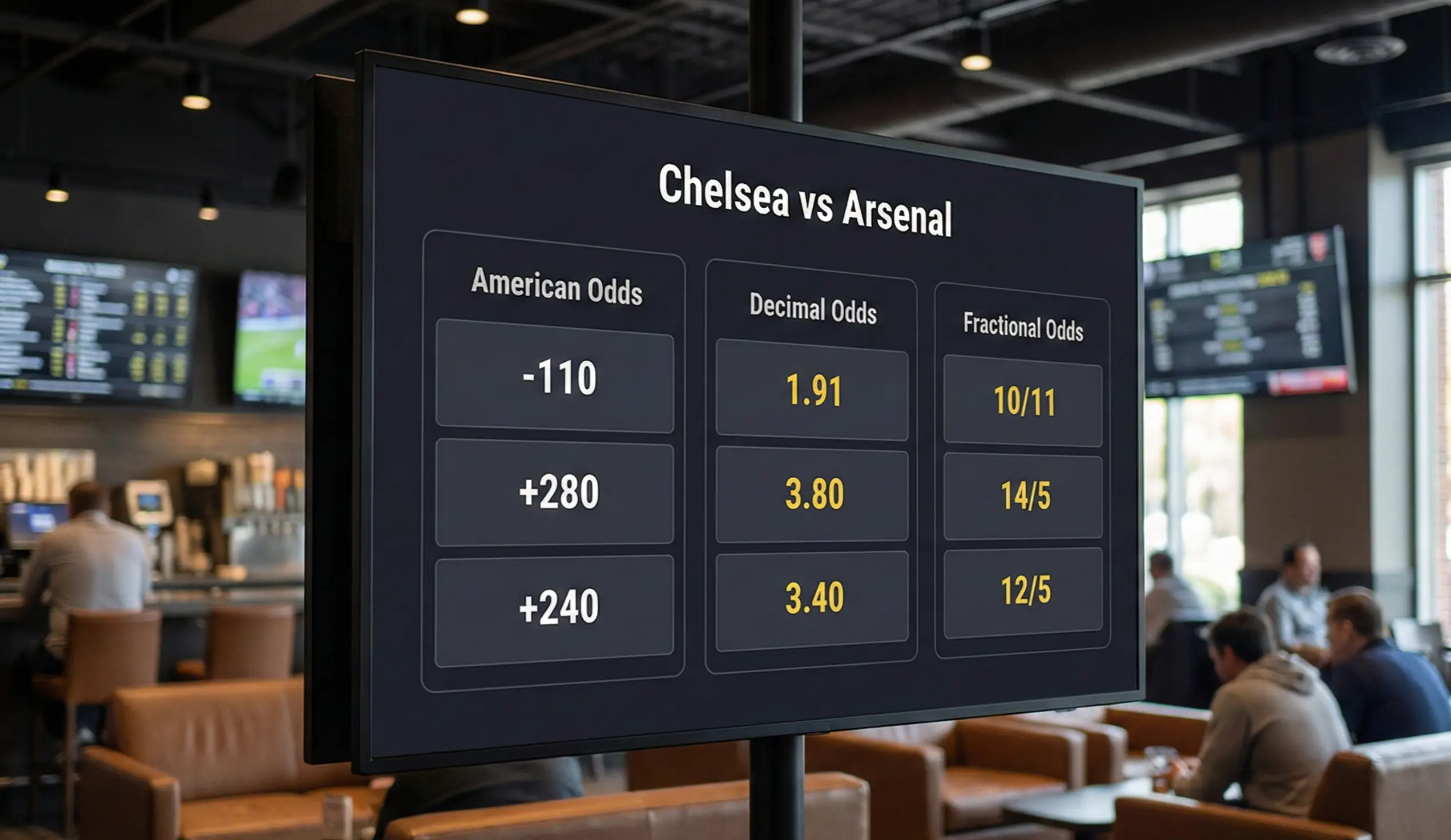
American odds display favorites with negative numbers (risk that amount to win 100) and underdogs with positive numbers (win that amount on a 100 stake). Also called moneyline odds in the US context.
Decimal odds express the total return per unit staked, including the stake itself. Odds of 2.50 mean a winning 10-unit bet returns 25 units total – 10 stake plus 15 profit.
Fractional odds show profit relative to stake as a ratio. Odds of 5/2 mean 5 units profit for every 2 units staked. Traditional in UK betting markets.
Even money or “evens” means a bet that doubles your money if successful – +100 in American odds, 2.00 in decimal, 1/1 in fractional. Implies approximately 50% probability before accounting for the vig.
Juice is the commission bookmakers charge for accepting bets, built into the odds themselves. Also called vigorish (vig), the juice ensures bookmaker profit regardless of outcomes. Standard juice on spread bets is approximately 4.5-5% of wagered amounts.
Vigorish (vig) is synonymous with juice. The term derives from a Russian word meaning “winnings” and entered English through gambling circles. When someone says “the vig is -110,” they mean you risk 110 to win 100 on a standard priced bet.
Implied probability translates odds into percentage likelihood of an outcome. Decimal odds of 2.50 imply 40% probability (1 divided by 2.50). Understanding implied probability helps evaluate whether odds represent value.
Overround (also called the book percentage) is the sum of implied probabilities across all outcomes in a market, which exceeds 100% due to the vig. An overround of 105% means the bookmaker has built in roughly 5% margin.
Price is another word for odds. When a bettor says “I got a good price,” they mean they secured favorable odds. Line shopping involves comparing prices across bookmakers.
True odds represent the actual probability of an outcome without bookmaker margin. True odds on a fair coin flip are +100 (2.00 decimal). Bookmaker odds for the same proposition might be -105 on each side, with the difference representing their edge.
Market and Bet Type Terminology
Moneyline is a bet on which team wins outright, with no spread involved. In Champions League, three-way moneylines include home win, draw, and away win as separate outcomes. Two-way moneylines (excluding draw) exist in markets where ties aren’t possible or are settled differently.
Point spread or simply “spread” handicaps the favorite by a specified margin. A -2.5 spread means the favorite must win by 3 or more goals. The spread levels the perceived playing field for betting purposes.
Asian handicap eliminates the draw from spread betting, refunding stakes on exact handicap draws at whole numbers or splitting bets between adjacent lines at quarter-goal intervals.
European handicap includes three outcomes after the handicap is applied: home cover, draw on handicap, away cover. Less common than Asian handicaps but still available at many bookmakers.
Totals or over/under bets predict whether combined scoring will exceed or fall below a specified number. Over 2.5 goals means three or more goals total; under 2.5 means two or fewer.
BTTS (Both Teams to Score) is a yes/no market on whether each team scores at least once. Also called “goal/no goal” at some bookmakers.
Draw no bet removes the draw from three-way match betting. If you back the favorite and the match draws, your stake returns. The favorite must win for the bet to profit; only an outright loss loses.
Double chance covers two of three match outcomes with one bet. Home/Draw means you profit if the home team wins or the match draws. Lower odds than single outcome betting but higher probability of success.
Parlay (also called an accumulator or acca) combines multiple selections into one bet requiring all legs to win for any return. Parlays multiply odds together, creating high potential payouts but low probability of success.
Prop bet (proposition bet) covers any outcome other than the final result – goalscorers, cards, corners, specific half results, and countless other markets. Props expand betting options beyond traditional match-level wagers.
Futures are long-term bets on outcomes determined later in a tournament or season – Champions League winner, top goalscorer, team to reach the final. Futures tie up your stake for extended periods.
Live betting (in-play betting) allows wagering after matches begin, with odds updating continuously based on match developments. A goal, red card, or injury dramatically shifts live betting lines.

Line Movement and Sharp Terminology
Opening line is the first price posted by a bookmaker on a market. Sharp bettors often seek to bet early, capturing value before lines move.
Closing line is the final price at kickoff. Consistently beating the closing line indicates betting skill, as it means you got better prices than the market ultimately settled on.
Steam or steam move describes rapid line movement caused by heavy betting on one side, often triggered by sharp action. Steam moves multiple bookmakers simultaneously when syndicates or respected bettors hit the same side across books.
Reverse line movement occurs when lines move opposite to the direction public betting suggests. If 70% of bets land on Team A but the line moves toward Team B, sharp money on Team B is outweighing square volume on Team A.
Buyback happens when sharp bettors on the original side of a line continue betting as the line moves, taking advantage of improved prices created by initial sharp action on the opposite side.
Middling involves betting both sides of a line at different numbers, hoping the final result falls between them for a double win. If you bet Team A -2.5 early and Team B +3.5 after line movement, a Team A win by exactly 3 wins both bets.
Push occurs when the result lands exactly on the spread or total, returning stakes to bettors on both sides. A -3 spread and a 3-goal margin of victory is a push.
Hang describes the practice of leaving a line available despite sharp action, often to gather intelligence on where smart money is flowing.
Bankroll and Staking Terminology
Flat betting means wagering the same amount on every bet regardless of confidence level. Many professionals advocate flat betting as protection against overconfidence and variance.
Kelly criterion is a mathematical formula for optimizing bet sizing based on edge and probability. Full Kelly is aggressive; fractional Kelly (betting a fraction of the calculated optimal stake) provides more conservative bankroll protection.
ROI (Return on Investment) measures betting profitability as a percentage of money wagered. A 5% ROI means 5 dollars profit for every 100 dollars bet, across all wagers regardless of outcome.
CLV (Closing Line Value) measures how your bet prices compare to closing lines. Consistently betting at prices better than closing lines indicates edge, even during losing streaks.
Chasing describes the destructive habit of increasing stakes after losses to recover quickly. Chasing almost always accelerates losses rather than recovering them.
Variance represents the inherent randomness in betting outcomes. Even skilled bettors experience losing streaks due to variance; proper bankroll management survives these periods.
Champions League-Specific Terms
League phase refers to the new 36-team single-table format replacing the traditional group stage as of 2024-25. Teams play eight matches against different opponents before knockout rounds.
Knockout phase playoff is the two-legged round between teams finishing 9th-24th in the league phase, determining who joins the top eight in the Round of 16.
Aggregate describes the combined score across two-legged ties. A 2-1 first leg and 1-0 second leg produces a 3-1 aggregate.
Away goals was the former tiebreaker awarding advancement to the team with more goals scored away from home on equal aggregate. UEFA abolished this rule in 2021; ties now proceed to extra time.
Dead rubber is a match with no competitive significance because both teams’ final positions are already determined. Late league phase matches sometimes become dead rubbers after teams secure qualification or elimination.
Coefficient is UEFA’s ranking system for clubs and nations based on European competition performance. Higher coefficient rankings earn more Champions League qualification slots for a nation’s clubs.
Understanding this vocabulary does more than help you navigate sportsbook interfaces – it lets you engage with betting discourse, evaluate strategies, and communicate with other bettors effectively. The terminology continues evolving as new markets emerge and betting culture develops, but these fundamentals provide the foundation for deeper engagement with Champions League betting.
Further, uncover tactical insights through our guide to betting on two-legged ties.
Regularly catch insights from champions-league-bet.com.
