
Correct Score Betting
 Available in US
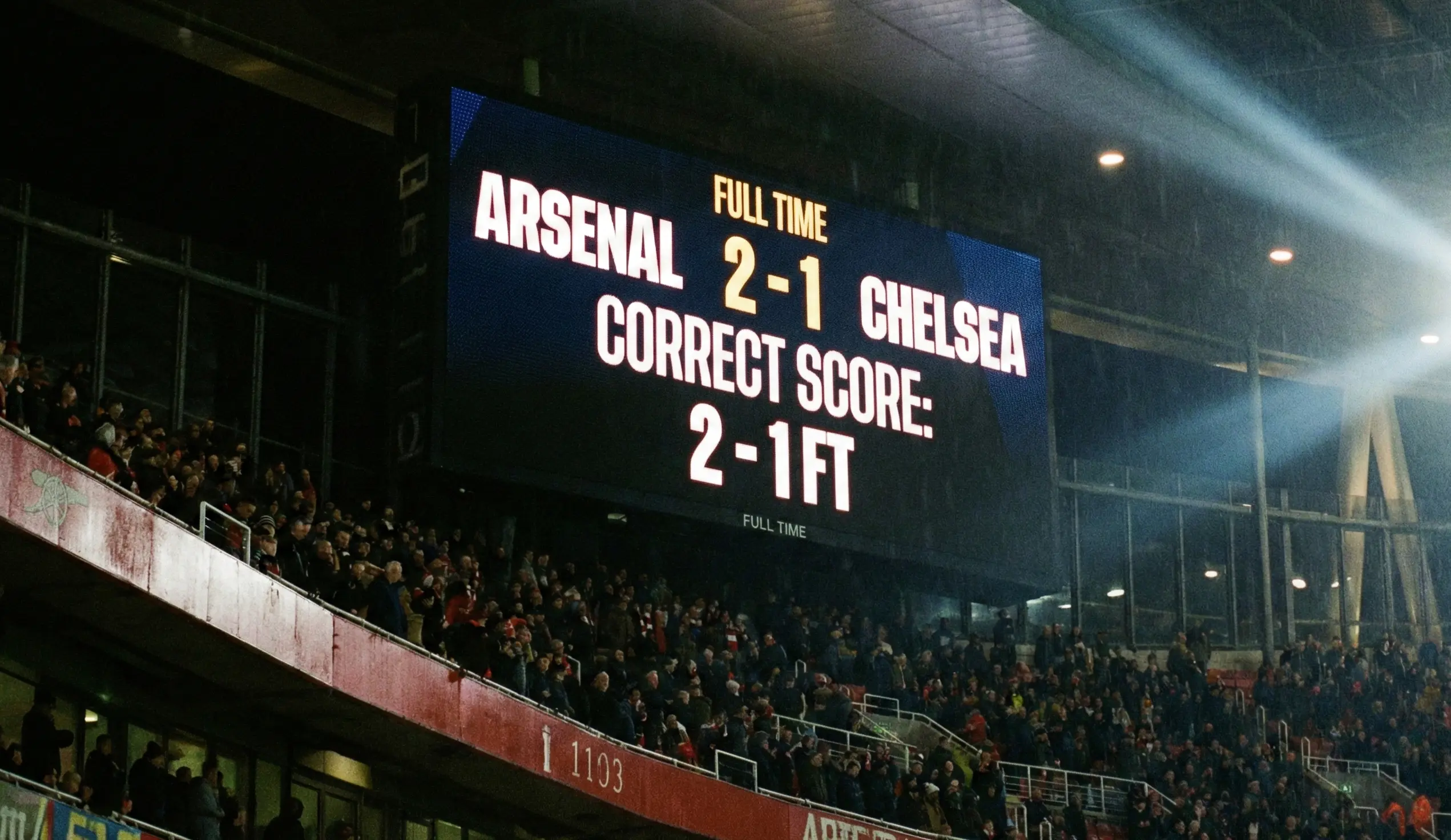
Correct score betting is football betting’s high-wire act. You’re not just predicting who wins or whether goals happen – you’re calling the exact final result. Miss by one goal and your bet is worthless. Nail it precisely and payouts can reach 10/1, 15/1, or even higher. The Champions League, with its mix of tactical chess matches and occasional blowouts, provides fertile ground for correct score bettors who understand both the appeal and the brutal mathematics of this market.
How Correct Score Betting Works
The premise couldn’t be simpler: predict the exact final score after 90 minutes plus stoppage time. Extra time and penalties in knockout matches don’t count for standard correct score bets – the market settles on regulation time. If you bet 2-1 and the match finishes 2-1, you win. If it finishes 2-2, 3-1, 1-1, or anything else, you lose. There’s no partial credit.
Bookmakers offer grids of possible scorelines, typically ranging from 0-0 through 4-4 or 5-5 for each team. Common results like 1-0, 2-1, and 1-1 carry shorter odds reflecting their frequency. Unusual results like 4-3 or 5-2 offer longer odds because they rarely occur. Most books also offer “any other” options covering scorelines not listed explicitly – the 6-0 thrashings and 5-4 thrillers that make headlines.
Odds on correct scores reflect genuine probability far more directly than match result betting. A 1-0 home win might be priced at 6/1, implying roughly 14% probability. A 4-0 might sit at 20/1, implying 5% probability. These numbers approximate how often each result actually occurs across large samples of matches, though bookmaker margins still apply.
The market’s appeal is obvious: high potential returns on small stakes. A $10 bet at 8/1 returns $90. But the appeal masks harsh reality – you’re betting against 7 other potential scorelines even within narrowly defined match outcomes. Correct score betting demands either acceptance of frequent losses or sophisticated approaches that manage variance.
Champions League Correct Score Patterns
Analyzing Champions League results reveals predictable patterns in scoreline distribution. The most common correct scores across recent seasons are 1-0, 2-1, 1-1, and 2-0. These four results alone account for roughly 40-45% of all matches. If you’re playing correct score markets without these scorelines in your portfolio, you’re swimming against statistical currents.
The 2024-25 league phase, with its 3.26 goals per game average, saw slightly higher scoring than historical norms. Results like 3-1 and 2-2 appeared more frequently than in defensive eras. Yet even in high-scoring seasons, low-margin results dominate. The median Champions League match produces 2-3 total goals; correct score betting should reflect this reality.
Knockout rounds produce different distributions than league phase matches. First legs particularly favor low-scoring results – 0-0, 1-0, and 1-1 comprise outsized shares of first-leg outcomes. The tactical caution of elimination football makes high-scoring predictions riskier. Second legs with aggregate deficits see more goals as trailing teams attack, but predicting exact scores becomes harder when desperation drives open play.
Mismatches between elite clubs and qualifiers produce predictable scoreline ranges but harder exact predictions. You might confidently expect Real Madrid to beat a Kazakh qualifier 3-0 or 4-0 – but which one? The difference between -4.0 and -3.0 margins affects correct score bets despite both being comfortable victories. This uncertainty persists even in seemingly predictable matches.

Strategies for Correct Score Betting
Single score selection is the purest approach: pick one scoreline and live or die with it. This strategy suits bettors with strong convictions about specific match textures. If you believe two defensive teams will battle to 1-1, backing that single score at 6/1 might offer value. The downside is obvious – you lose seven of eight times even when your general read is correct.
Score casting or dutching involves backing multiple scorelines simultaneously, accepting reduced overall odds in exchange for increased hit probability. If you expect a 2-1 or 3-1 home win, backing both at their respective odds creates a combined position. Your total stake exceeds what you’d risk on a single selection, but your coverage improves.
The mathematics of dutching requires calculating stake distribution to equalize potential returns or optimize expected value. If 2-1 is available at 7/1 and 3-1 at 12/1, and you want equal returns from either outcome, you’d stake more on the shorter price. Dutching calculators automate these computations, but understanding the underlying logic helps you evaluate whether combined positions offer genuine value.
Scorecast and wincast bets combine correct score with goalscorer markets. Predict 2-1 AND Harry Kane to score first for enhanced odds versus either selection alone. The correlation between selections – Kane scoring increases 2-1 probability if England is expected to win 2-1 – means odds don’t simply multiply, but these combinations can find value when your analysis aligns across both dimensions.
Analyzing Matches for Correct Score Value
Start with expected match texture. Will this be an open, attacking affair with goals at both ends? A defensive battle where chances are scarce? A mismatch where one team dominates? Your texture assessment narrows the range of plausible scorelines before you evaluate specific numbers.
Statistical inputs inform scoreline probability. Team A scores 1.8 goals per home match on average; Team B concedes 1.2 per away match. These numbers suggest Team A scoring 1-2 goals is most likely, with 0 and 3 as reasonable outliers. Team B’s scoring rate in away matches suggests 0-1 goals. Combining these distributions points toward results like 2-0, 2-1, 1-0, 1-1 as most probable.
Context modifies statistical expectations. A team resting players before a bigger match might underperform their averages. A team fighting for qualification with season on the line might overperform. Motivation, fatigue, injury impacts, tactical matchup specifics – these qualitative factors adjust the probability distributions your statistical analysis produces.
Compare your estimated probabilities to odds-implied probabilities. If your analysis suggests 2-1 has 15% probability but odds imply only 10%, you’ve potentially found value. The margin between your estimate and the market’s must be significant given correct score betting’s high variance – small edges get swamped by luck over typical sample sizes.
Managing Correct Score Variance
Correct score markets have inherent high variance regardless of your analytical skill. Even excellent bettors with genuine edge experience long losing streaks because hitting exact scores is genuinely difficult. Accepting this variance psychologically is prerequisite to sustainable correct score betting.
Stake sizing must reflect hit rate expectations. If you expect to hit one in eight correct score bets, risking 5% of your bankroll per bet means potential 35% drawdowns during normal cold streaks. More conservative sizing – 1% or less per correct score selection – provides necessary cushion.
Tracking results over statistically meaningful samples reveals whether your approach adds value. Twenty or thirty correct score bets won’t tell you much – variance dominates. One hundred or more bets start revealing patterns. Are you hitting at rates your odds suggest you should? Above that rate suggests edge; below suggests your analysis isn’t outperforming the market.
Consider correct score bets as entertainment spending rather than profit-seeking investment. The thrill of nailing an exact prediction provides genuine enjoyment. If you’re staking money you’re comfortable losing for that entertainment, correct score betting delivers value regardless of results. If you’re depending on correct score profits for serious returns, recalibrate expectations.

Common Correct Score Mistakes
Backing scorelines because they “feel right” without analytical support is pure gambling. The sense that “this feels like a 2-1 game” reflects nothing unless grounded in team statistics, tactical analysis, and context evaluation. Feelings aren’t edge.
Overweighting recent results produces systematic errors. If a team won 4-0 last week, the temptation to back 4-0 again this week ignores regression to mean, opponent differences, and natural variance. Each match is independent; last week’s score has minimal predictive value for this week.
Chasing losses with larger correct score stakes accelerates bankroll destruction. After five consecutive losing picks, doubling your stake on the sixth doesn’t improve your probability of winning – it just increases your potential loss. The variance that caused the losing streak continues regardless of stake size.
Ignoring the “any other score” or high-score options when they’re genuinely possible leaves value unexploited. In mismatches where 5-0 or 6-1 might occur, the “any other home win” option at 15/1 sometimes offers better expected value than specific high-scoring predictions at 20/1 or longer.
When to Avoid Correct Score Betting
Matches with high uncertainty about basic outcome – coin-flip affairs between evenly matched teams – make correct score prediction nearly impossible. When you can’t confidently predict the winner, adding margin prediction compounds difficulty exponentially. These matches favor simpler betting approaches.
Second legs with significant aggregate leads see reduced intensity that makes scoring patterns unpredictable. The leading team might protect their advantage with defensive posture or continue attacking. The trailing team might surrender or fight desperately. These tactical uncertainties cascade into scoreline unpredictability.
Matches involving teams you don’t know well enough to analyze properly should be avoided for correct score purposes. Generic statistics without contextual understanding produce generic predictions that rarely outperform market prices. If you haven’t watched a team play, you don’t understand their match texture well enough to predict exact scores.
Knockout finals and decisive matches produce psychological pressures that distort normal patterns. Players might freeze under pressure, leading to missed chances and scoreless frustrations. Or the occasion might inspire extraordinary performances. Either way, the unpredictability exceeds what statistical analysis can capture.
Building Correct Score Proficiency
Develop deep knowledge of specific teams rather than spreading attention across the entire Champions League. Understanding how Barcelona creates chances, how Inter defends, how Dortmund’s matches typically flow provides the contextual insight that generic statistics lack. Specialist knowledge beats generalist breadth for correct score purposes.
Create systematic pre-match analysis routines that produce probability distributions across scorelines. What’s your estimate for 0-0? For 1-0? For 2-1? For 3-0? Formalizing your predictions – even if imprecise – enables comparison against odds and identification of potential value.
Review your predictions against outcomes regardless of whether you bet. Did your process identify the actual result as reasonably probable? If you consistently rate actual results as unlikely, your process needs refinement. If you rate them as probable but the odds didn’t offer value, your process works but the market is efficient.
Accept that correct score betting may not suit your temperament or bankroll. The combination of high variance and frequent losses creates psychological stress that some bettors handle poorly. Recognizing correct score limitations – and redirecting to markets that match your profile better – is strategic wisdom, not defeat.
Check out our list of the best Champions League bets to get winning tips.
For more information, visit the main website.
