
Understanding Betting Lines
 Available in US

When Manchester City faces a Kazakh qualifier in the league phase, the moneyline odds might offer -500 on City – meaning you’d risk 500 to win 100. That’s terrible value for the bettor, and it’s precisely where betting lines and spreads become essential tools. Rather than simply picking winners at unfavorable prices, spreads let you bet on margins of victory, transforming mismatches into competitive betting propositions. Mastering these markets opens up Champions League fixtures that the moneyline renders essentially unbettable.
What Betting Lines Actually Represent
A betting line is the bookmaker’s way of framing a contest for wagering purposes. In its purest form, the line establishes the terms of the bet – who’s favored, by how much, and at what price. Lines aren’t predictions of final scores; they’re numbers set to attract balanced betting action on both sides. Bookmakers want roughly equal money on both outcomes because that guarantees profit through the vigorish regardless of the result.
The opening line represents the bookmaker’s initial assessment of a match, typically released two to three days before kickoff for Champions League fixtures. From that moment, the line lives and breathes. It moves in response to betting volume, injury news, lineup information, and even weather forecasts. A line that opens at -3.5 for Bayern Munich might sit at -4 by kickoff if heavy money backs Bayern, or retreat to -3 if sharp bettors pound the underdog.
Understanding that lines are designed to split action rather than predict outcomes changes how you approach them. When a line moves, it’s not necessarily the bookmaker updating their opinion of the match – it’s the bookmaker responding to market forces. Sometimes the public overreacts to recent results and pushes a line too far. Sometimes professional bettors identify value and correct a mispriced opening. Reading these movements requires experience, but recognizing that lines have commercial rather than purely analytical purposes is the first step.
Point Spreads in Football Context
In American sports betting terminology, the point spread handicaps the favorite by requiring them to win by a specified margin. Football betting uses goal-based spreads, but the principle is identical. If Liverpool is listed at -1.5 against Atalanta, Liverpool must win by two or more goals for spread bettors to cash. Atalanta at +1.5 can lose by one goal, draw, or win outright – any of those outcomes covers the spread.
The half-goal increment (-1.5 rather than -1) eliminates push outcomes where nobody wins or loses. A match result that lands exactly on a whole-number spread would refund all bets at that number, which bookmakers avoid when possible. By setting lines at 1.5, 2.5, or 3.5, every match produces winners and losers. Some markets do offer whole-number spreads with push possibilities, particularly in Asian handicap formats, but the American-style point spread typically avoids this.
Spread betting transforms how you analyze matches. Instead of asking “Will Inter beat Benfica?” you’re asking “Will Inter beat Benfica by two or more goals?” These are substantially different questions. Inter might dominate possession and create chances while winning 1-0 on a clinical counter – a profitable moneyline bet but a losing -1.5 spread ticket. Conversely, a 3-1 victory that feels comfortable covers the spread even if Inter wasn’t the better team for stretches of the match.
The spread equalizes betting action on mismatches by giving underdogs a head start. When Barcelona faces a Swiss club, the moneyline might be -400 Barcelona – unappealing for bettors and risky for the bookmaker if everyone piles on the obvious favorite. A spread of Barcelona -2.5 creates balanced interest: some bettors believe Barcelona wins big, others think the underdog keeps it close. The bookmaker collects vigorish from both sides regardless of outcome.
European Handicaps and the Draw Option
European handicap betting includes the draw as a possible outcome, unlike Asian handicaps which eliminate it. If you back Real Madrid at -1 European handicap, three things can happen: Madrid wins by two or more (you win), Madrid wins by exactly one (the draw after handicap is applied, so you lose if you didn’t bet the draw), or Madrid fails to win by any margin (you lose). The draw option on the handicap creates additional betting complexity and typically worse odds than equivalent Asian markets.
This format resembles traditional three-way moneyline betting but with adjusted goal conditions. The bookmaker effectively asks: if we subtract one goal from Real Madrid’s final score, what happens? A 2-0 Madrid win becomes 1-0 with handicap applied – Madrid covers. A 1-0 Madrid win becomes 0-0 – a handicap draw. A 1-1 actual draw becomes 0-1 after handicap – the underdog covers.
European handicaps appear frequently at UK-facing bookmakers and in traditional betting contexts. They offer betting opportunities on margins while acknowledging that exact-margin outcomes (like winning by precisely one goal) happen often enough in football to warrant their own market. The prices typically favor Asian handicaps for pure value, but European handicaps suit bettors who want the option to back the handicap draw.
Asian Handicap Essentials
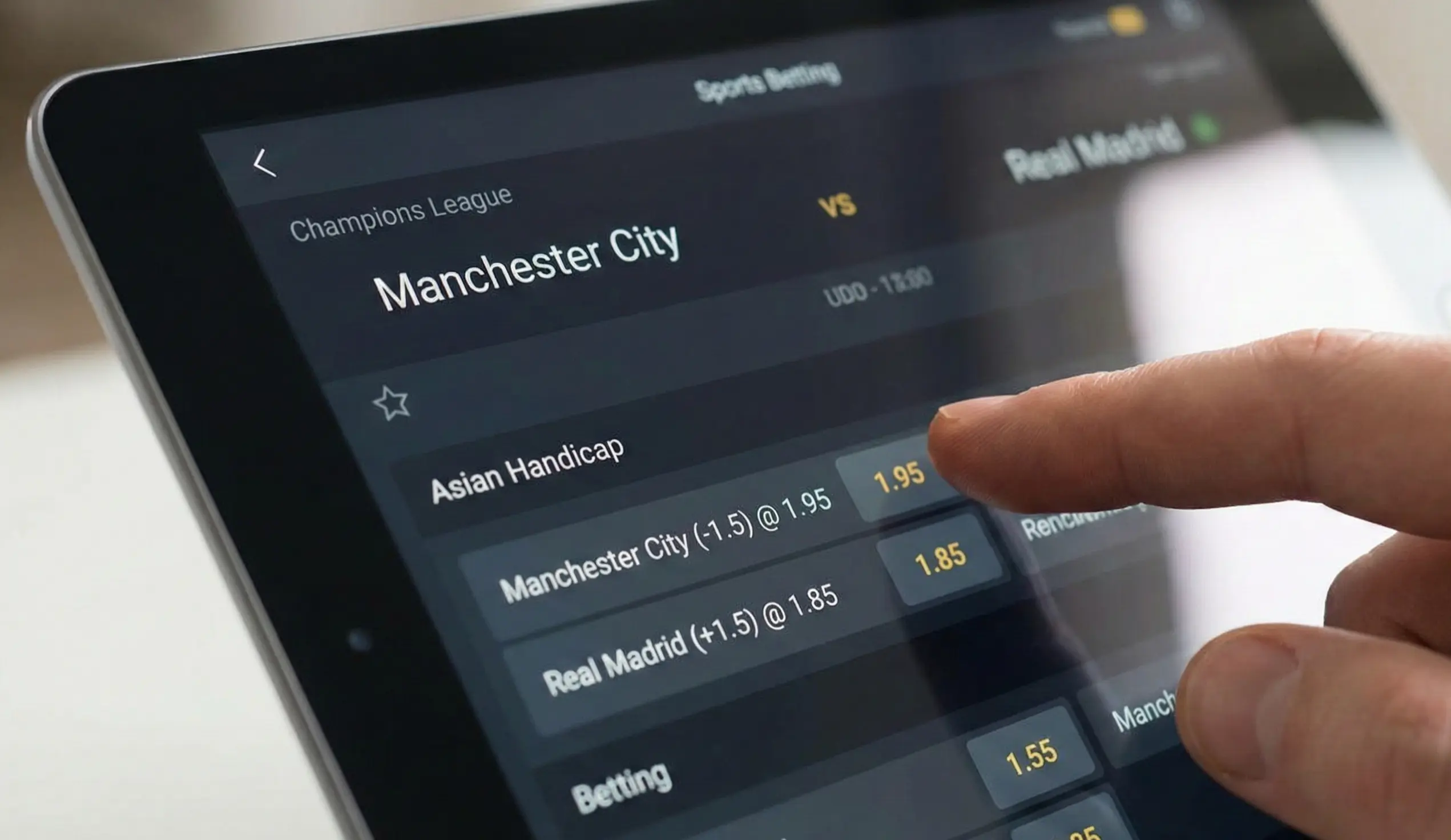
Asian handicaps originated in Indonesia and have become the preferred spread format for football bettors worldwide. The key innovation is eliminating the draw: every Asian handicap market produces a winner and a loser (or a push at whole-number handicaps). This two-way structure means higher effective odds on each side compared to three-way European markets.
Half-goal handicaps (-0.5, -1.5, -2.5) work straightforwardly. At -0.5, the favorite must win by any margin. At -1.5, they must win by two or more. At +1.5, the underdog can lose by one and still cover. No draw outcomes exist because half-goals cannot be matched exactly.
Whole-goal handicaps (-1, -2, -3) introduce push possibilities. If you back Arsenal at -1 and they win 2-1, your bet pushes – stake returned, no profit, no loss. This isn’t a draw you could have bet; it’s simply an outcome where neither side wins the handicap. Some bettors appreciate this insurance; others prefer the cleaner half-goal markets.
Quarter-goal handicaps (-0.25, -0.75, -1.25) split your stake between two adjacent lines. A -0.75 bet puts half your stake on -0.5 and half on -1. If the favorite wins by exactly one, you win half your bet (the -0.5 portion) and push the other half (the -1 portion). This fractional system provides granular positioning between major handicap levels and creates intermediate payout outcomes.
Reading Spread Prices and Finding Value
Spread markets carry their own pricing structure separate from the handicap number itself. The handicap tells you the margin required; the odds tell you what you’re paid for accepting that margin. A standard American spread price is -110 on both sides, meaning both favorite and underdog bettors risk 110 to win 100. When spreads drift from this standard, pay attention.
If Barcelona -2.5 is priced at -120 while the underdog +2.5 sits at even money (+100), the bookmaker is indicating more money or sharper money has landed on Barcelona. They’ve adjusted the price to discourage further Barcelona action while making the underdog more attractive. This doesn’t necessarily mean the underdog is the right bet – it means the market has moved toward Barcelona and the bookmaker is rebalancing.
Shopping for the best spread prices matters just as shopping for odds matters in any market. One bookmaker might offer Bayern Munich -2 at -105 while another has Bayern -2 at -115. Same handicap, different price. Over hundreds of bets, these small differences compound significantly. Serious bettors maintain accounts at multiple books specifically to capture the best available line on any given bet.
Value in spread betting emerges when your assessment of probable margin differs from the market’s. If you believe Chelsea will dominate a mid-tier opponent and likely win by three or more goals, Chelsea -2.5 at -110 offers value even if Chelsea only covers 45% of the time – because breaking even requires only about 47.6% at -110 odds. Your edge is the gap between the required hit rate and your estimated probability.

Spread Betting Strategy for Champions League
The Champions League’s structure creates specific spread-betting patterns worth understanding. League phase matches between seeded giants and qualifying minnows regularly produce double-digit point spreads – situations almost unique to this competition. Spreads of -3.5 or -4.5 appear routinely when powerhouses host weaker opponents. These high spreads require significant blowouts to cover, which happen less consistently than you might expect even in mismatches.
Knockout football dramatically changes spread dynamics. The two-legged format means teams that win the first leg comfortably often protect their advantage in the second rather than pushing for more goals. A team leading 3-0 from the first leg might field a rotated squad and absorb pressure in the return match, resulting in a draw or narrow loss. Betting second-leg spreads requires accounting for first-leg context – a consideration that doesn’t exist in single-match league phase betting.
The intensity of Champions League football also affects margins. Elite teams don’t blow each other out frequently. When Barcelona and Bayern meet, a 1-0 or 2-1 result is far more likely than a 4-0 thrashing. Setting appropriate expectations about scoring margins in competitive fixtures prevents you from chasing unrealistic spreads. Underdogs cover more often against elite opponents in the Champions League than casual bettors assume, precisely because the talent gap is smaller than domestic league mismatches.
Late-stage league phase matches present spread-betting opportunities tied to motivation and lineup decisions. A team locked into their final position might rest key players, dramatically altering the expected margin against an opponent fighting for playoff survival. Conversely, a powerhouse guaranteed to advance might still push for goal difference advantage, maintaining spread-covering intensity. Reading team motivations before the final league phase matchdays provides an edge that pure form analysis misses.
Common Mistakes in Spread Betting
Betting heavy favorites on big spreads feels safe but carries substantial risk. When you back Real Madrid -3.5 at -110, you need them to score four more goals than their opponent (or three more and prevent any opponent scoring). One opponent goal, one Madrid finishing issue, one outstanding opposing goalkeeper performance – suddenly covering a 3.5-goal spread becomes unlikely. Laying large spreads against any opponent capable of scoring makes success contingent on dominant performance, and dominance is never guaranteed.
Confusing spread betting with prediction is another trap. You’re not predicting the exact margin; you’re betting on whether the margin exceeds or falls short of a specified number. If you believe Liverpool wins 2-1, betting Liverpool -1.5 loses even though your prediction was correct. Spread betting requires thinking in terms of thresholds, not point estimates.
Ignoring the price side of the spread equation undermines bankroll management. A -1.5 spread at -130 requires roughly 56.5% accuracy to break even. The same spread at -105 requires only about 51.2%. These differences matter enormously over sample sizes large enough to produce meaningful results. Bettors who grab spreads without comparing prices across books leave value on the table consistently.
Finally, failing to adjust spread expectations for competition context burns Champions League bettors repeatedly. A team that covers -3.5 regularly in their domestic league faces different caliber opposition in Europe. Bundesliga dominance doesn’t guarantee Champions League blowouts. Spreading the same numbers across different competitive environments ignores the variable that matters most: opponent quality.
For various betting options, refer to our coverage on Champions League Player Props.
For more resources, always rely on the main domain for accurate information.
