
Betting Odds Explained
 Available in US

Odds are the language of sports betting, and if you can’t read them fluently, you’re essentially placing bets blindfolded. When you see Bayern Munich listed at -180 or 1.56 or 4/7 against a smaller opponent, those numbers are telling you the same story in three different dialects. Understanding what each format communicates – and more importantly, what it reveals about probability and potential profit – transforms you from a confused newcomer into someone who can evaluate betting opportunities with clarity.
The Three Languages of Betting Odds
Different regions of the world developed their own conventions for expressing betting odds, and none has emerged as the universal standard. American odds dominate in the United States and are increasingly common on international platforms that cater to American bettors. Decimal odds rule across continental Europe, Canada, and Australia. Fractional odds remain the traditional format in the United Kingdom and Ireland, particularly for horse racing and football. Any serious Champions League bettor encounters all three formats regularly, and the ability to convert between them becomes second nature with practice.
Each format conveys the same underlying information: the implied probability of an outcome and the return you’ll receive if your bet wins. They’re not different odds – they’re different ways of expressing identical mathematical relationships. A bettor who understands this can shop for the best prices across multiple bookmakers regardless of which format each uses, which is precisely the kind of edge that separates successful bettors from the crowd.
The format you prefer often comes down to what you learned first and what calculations feel most intuitive. Many experienced bettors set their preferred sportsbooks to display decimal odds because the math is simplest, even if they grew up reading American or fractional formats. Others stick with what feels comfortable. There’s no wrong answer here – only the requirement that you actually understand whichever format you use.
American Odds: Plus and Minus Signs
American odds, also called moneyline odds, revolve around a baseline of 100 units. The system uses positive and negative numbers to distinguish favorites from underdogs and to indicate potential payouts. If you see a negative number, you’re looking at a favorite. If you see a positive number, that’s an underdog. The magnitude of the number tells you how much you need to stake or how much you stand to win.
Negative odds indicate the amount you must risk to win 100 units. When Manchester City is listed at -200 against a league phase opponent, you need to stake 200 dollars (or pounds, or euros) to profit 100. If City wins, you receive your 200 stake back plus 100 in profit, totaling 300. The larger the negative number, the heavier the favorite. Odds of -400 require a 400 stake to profit 100, indicating a team the bookmaker considers highly likely to win.
Positive odds indicate the profit you’ll receive on a 100-unit stake. If the underdog is listed at +350, a successful 100-dollar bet returns 350 in profit plus your original stake, totaling 450. Longer odds mean bigger underdogs and larger potential payouts. A team at +1000 offers 10-to-1 returns – stake 100 and profit 1000 if they pull off the upset.
The practical calculations work like this. For favorites with negative odds, divide 100 by the absolute value of the odds and multiply by your stake to find your profit. At -150 odds with a 75-dollar stake: 100 divided by 150 equals 0.667, multiplied by 75 equals 50 dollars profit. For underdogs with positive odds, divide the odds by 100 and multiply by your stake. At +200 odds with a 50-dollar stake: 200 divided by 100 equals 2, multiplied by 50 equals 100 dollars profit.
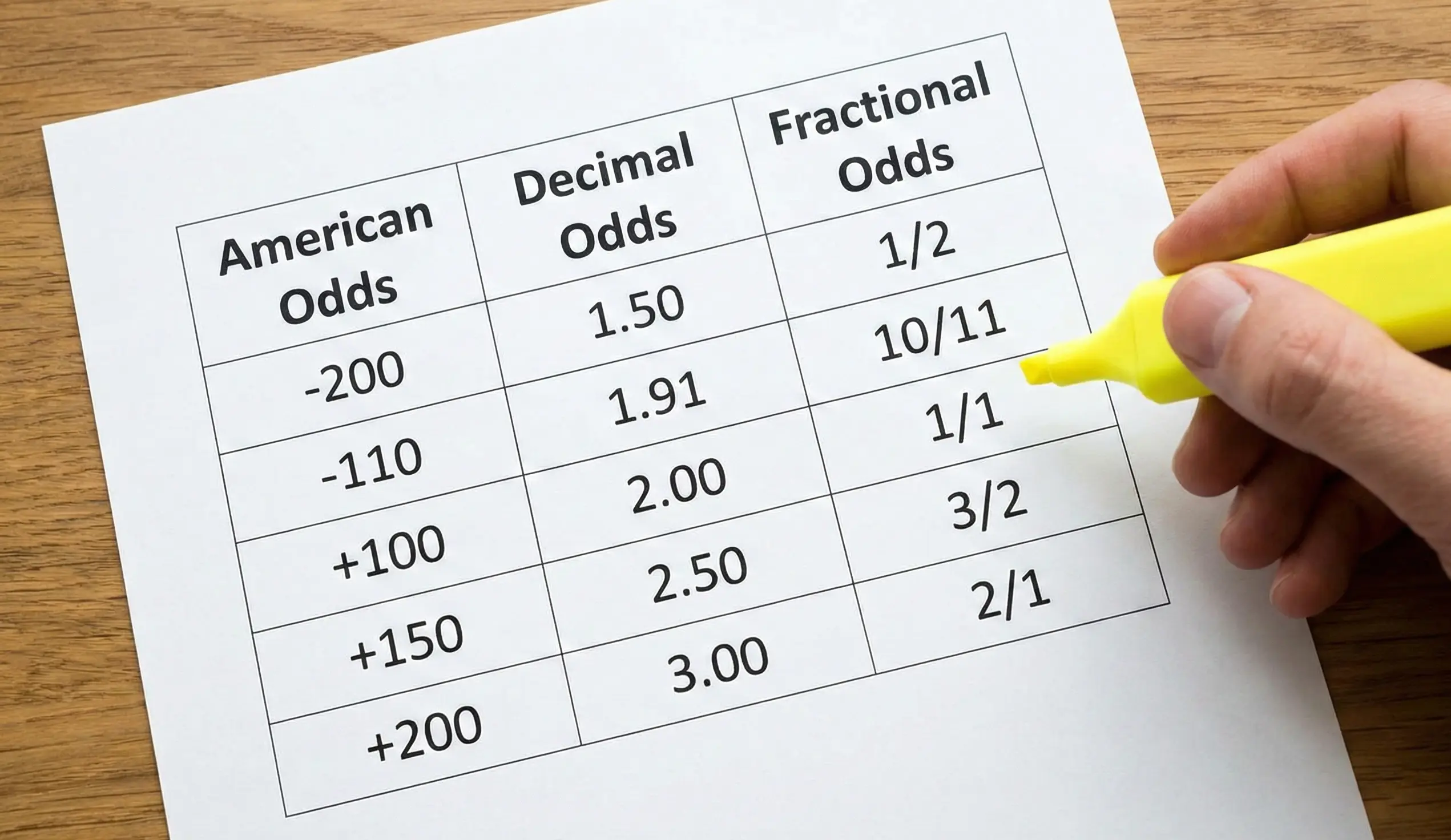
Decimal Odds: Straightforward Multiplication
Decimal odds enjoy popularity across Europe precisely because they simplify the math that American and fractional formats complicate. A decimal number represents your total return per unit staked, including your original stake. Multiply your stake by the decimal odds, and you get your total return if the bet wins. No separate calculations for profit – it’s all in one number.
When Real Madrid is listed at 1.40 against a weaker opponent, a 100-euro stake returns 140 euros total if Madrid wins: your 100 back plus 40 in profit. Barcelona at 2.50 against a more competitive side returns 250 euros on that same 100-euro stake: 100 back plus 150 profit. The higher the decimal number, the less likely the bookmaker considers that outcome and the more you stand to gain.
Decimal odds of 2.00 represent even money – stake 100, return 200 if you win, netting 100 profit. Anything below 2.00 is a favorite; anything above 2.00 is an underdog. This clean breakpoint makes evaluating odds intuitive. When you see 1.25, you know immediately that’s a heavy favorite offering modest returns. When you see 5.00, that’s a clear underdog where success quadruples your money.
Converting decimal odds to implied probability requires dividing 1 by the decimal odds. At 2.50 odds, the implied probability is 1 divided by 2.50, which equals 0.40 or 40%. This tells you the bookmaker believes this outcome has roughly a 40% chance of occurring – though the true probability is slightly lower because the vig inflates all odds prices. Understanding implied probability helps you evaluate whether odds accurately reflect your own assessment of likely outcomes.
Fractional Odds: The Traditional Format
Fractional odds express the potential profit relative to the stake as a ratio. The first number (numerator) represents profit; the second number (denominator) represents the stake required. At 5/2 odds, you profit 5 units for every 2 units staked. A 20-pound bet at 5/2 returns 50 pounds profit plus your 20 stake, totaling 70.
The format takes some mental adjustment for those who didn’t grow up with it. Odds of 1/4 mean you profit 1 unit for every 4 staked – a heavy favorite. Odds of 4/1 mean you profit 4 units for every 1 staked – a clear underdog. The relationship between numerator and denominator tells you whether you’re looking at a favorite (denominator larger) or underdog (numerator larger). Even money appears as 1/1 or “evens.”
Common fractional odds you’ll encounter on Champions League matches include 10/11 (slight favorite), 6/4 (moderate underdog), 7/2 (substantial underdog), and 20/1 (significant longshot). British bookmakers traditionally use standardized fractions – 5/4 rather than 1.25/1 – which can initially confuse bettors accustomed to cleaner decimal expressions.
Calculating total return from fractional odds requires an extra step compared to decimals. Divide the numerator by the denominator, add 1, then multiply by your stake. At 7/4 odds with a 40-pound stake: 7 divided by 4 equals 1.75, plus 1 equals 2.75, multiplied by 40 equals 110 pounds total return. The profit component is 70 pounds, matching what you’d calculate by multiplying 40 by 7/4 directly.
Converting Between Formats
Fluent conversion between formats lets you compare prices across bookmakers using different standards. The conversions aren’t complicated once you’ve done them a few times.
Decimal to American: For decimal odds of 2.00 or higher, subtract 1 and multiply by 100 to get positive American odds. Decimal 3.50 becomes (3.50 – 1) x 100 = +250. For decimal odds below 2.00, divide -100 by (decimal minus 1). Decimal 1.50 becomes -100 / (1.50 – 1) = -200.
American to Decimal: For positive American odds, divide by 100 and add 1. American +150 becomes (150 / 100) + 1 = 2.50. For negative American odds, divide 100 by the absolute value and add 1. American -200 becomes (100 / 200) + 1 = 1.50.
Fractional to Decimal: Divide the numerator by the denominator and add 1. Fractional 5/2 becomes (5 / 2) + 1 = 3.50.
Decimal to Fractional: Subtract 1 from the decimal and express as a fraction. Decimal 2.50 becomes 1.50, which is 3/2. Converting to traditional British fractions sometimes requires rounding or expressing unusual ratios.
Most online sportsbooks let you toggle between formats in your account settings, so you can view all odds in whichever format you prefer. But understanding the conversions matters for mental math, comparing prices across platforms that use different defaults, and building intuition for value.
Implied Probability and the Bookmaker’s Edge
Every odds price contains an implied probability – the chance of an outcome that would make the bet break even over the long run. Calculating implied probability from decimal odds requires dividing 1 by the odds. From American odds: for positive odds, divide 100 by (odds + 100); for negative odds, divide the absolute value of odds by (absolute value + 100). From fractional odds, divide the denominator by (numerator + denominator).
Here’s where it gets interesting. If you calculate implied probabilities for all outcomes of a Champions League match – home win, draw, away win – and add them together, you won’t get 100%. You’ll get something higher, typically between 102% and 108% depending on the bookmaker and market. This excess represents the overround, the margin built into odds that guarantees the bookmaker profits regardless of outcome. It’s the same concept as the vig or juice in American betting parlance.
A match where the bookmaker’s implied probabilities total 105% means they’ve inflated every outcome’s probability by a proportional amount. The true probabilities of all outcomes sum to exactly 100%, but the bookmaker has padded their numbers. Your job is to identify situations where an outcome’s true probability exceeds what the odds imply even after accounting for this margin. When you find those spots, you’ve found value.

Reading Line Movement and Market Signals
Odds aren’t static. From the moment a bookmaker posts opening lines until kickoff, prices shift based on betting action, news developments, and injury updates. Understanding line movement helps you time your bets and interpret what the market is telling you.
When heavy money lands on one side, bookmakers adjust odds to balance their liability. If Real Madrid opens at -150 and moves to -180, sharp bettors hammered Madrid early. Either they spotted value the bookmaker mispriced, or significant news broke that increased Madrid’s winning probability. Conversely, if an underdog’s odds shorten from +300 to +250, money is flowing toward the upset.
Steam moves represent rapid, significant line changes driven by professional betting action. When sharp bettors at multiple sportsbooks simultaneously bet the same side, odds shift quickly across the market. Following steam moves can capture value if you act before lines adjust fully, though chasing every line movement without understanding why is a recipe for confusion.
The goal isn’t to blindly follow line movement but to understand what it reveals. Sometimes early movement corrects a mispriced opening line. Sometimes it reflects public bias toward popular teams. Sometimes it’s driven by injury news you haven’t heard yet. Reading these signals in context – combined with your own analysis – produces better betting decisions than either ignoring the market or following it mindlessly.
Practical Application for Champions League Betting
When you pull up a Champions League match at your sportsbook, you’ll see odds across multiple markets: match result, total goals, both teams to score, goalscorer props, and more. Each market tells a story about what the bookmaker expects to happen. Cross-referencing these markets reveals the bookmaker’s underlying view of the match.
If Liverpool is favored to beat a midtable European side and over 2.5 goals is priced below even money, the bookmaker expects Liverpool to win comfortably with goals. If both teams to score is priced at long odds for “yes,” the bookmaker expects Liverpool to dominate while the opponent struggles to create chances. These signals help you evaluate whether your match analysis aligns with market pricing.
The Champions League’s concentration of elite clubs produces many heavy favorites during the league phase when top seeds face weaker opposition. Odds of -300 or 1.33 are common for mismatches. These prices offer little profit potential and carry meaningful risk – upsets happen, and one loss at heavy odds requires multiple wins to recover. The format’s mix of lopsided and competitive fixtures creates varying betting textures across the 144 league phase matches, rewarding bettors who adjust their approach based on match context rather than applying a one-size-fits-all strategy.
Learn about Asian Handicap betting through our Asian Handicap article.
For further inquiries, feel free to visit champions-league-bet.com.
